Shingle Roof Fall Protection Queens NY – What Safety Requires | Free Quotes
Gravity doesn’t care if you’re a pro or a DIY hero-on a sloped shingle roof in Queens, the most expensive part of the job isn’t the shingles, it’s the fall that happens when someone decides safety is “extra.” Around Queens I’m known as the “harness lady” because nobody steps onto a pitched roof without a mapped-out safety plan, and after 19 years on these roofs, I’ve earned that nickname by refusing to let close calls turn into ambulance rides.
Why Shingle Roof Fall Protection Isn’t Optional in Queens
Gravity. One July afternoon, about 3:30, sun bouncing off the shingles hard enough to cook an egg, I watched a DIY‑minded homeowner in Astoria step backward toward a valley while showing me “how he’d been doing it.” His sneaker hit a loose granule patch and his feet went right out from under him-he only stopped because his heel caught the gutter. I was close enough to grab his wrist, and we sat there on the edge, both breathing hard, while I explained that with a $250 temporary anchor and harness setup he never would’ve gotten that far into danger. That uncomfortable truth is what every Queens homeowner needs to hear: the most expensive part of shingle work isn’t the materials or labor, it’s the fall nobody planned for. Any shingle job without a fall plan is reckless, period-and I refuse to sugarcoat that or run a job that treats safety like an optional upgrade. I describe roofs the way I used to trace signal lines on transit diagrams: every roof is a map with danger zones and safe anchor “stations,” and you don’t send people onto the tracks without knowing where the switches are.
On a typical two‑story Queens colonial with a 6/12 pitch, the first thing I do is mentally map routes, choke points, valleys, skylights, and where anchors go before anyone steps off the ladder. These roofs-usually 18 to 30 feet to the ground, steep enough that you’re sliding not walking, covered in loose granules or wet from a quick drizzle-make falls especially likely. Mix in Queens weather-sudden wind gusts off the water in Bayside, freeze-thaw cycles all winter, summer heat breaking down shingle surfaces-and you’ve got a roof that can turn from solid to slippery in minutes. This map‑mindset isn’t about being paranoid; it’s about being predictable and organized. And here’s the thing: homeowners should demand to see a safety plan before work starts, the same way you’d want to see a route map before boarding a train in a new city.
Queens Shingle Roof Fall Risk Snapshot
What Safe Shingle Roof Work Looks Like in Queens, NY
Required Gear and Setup
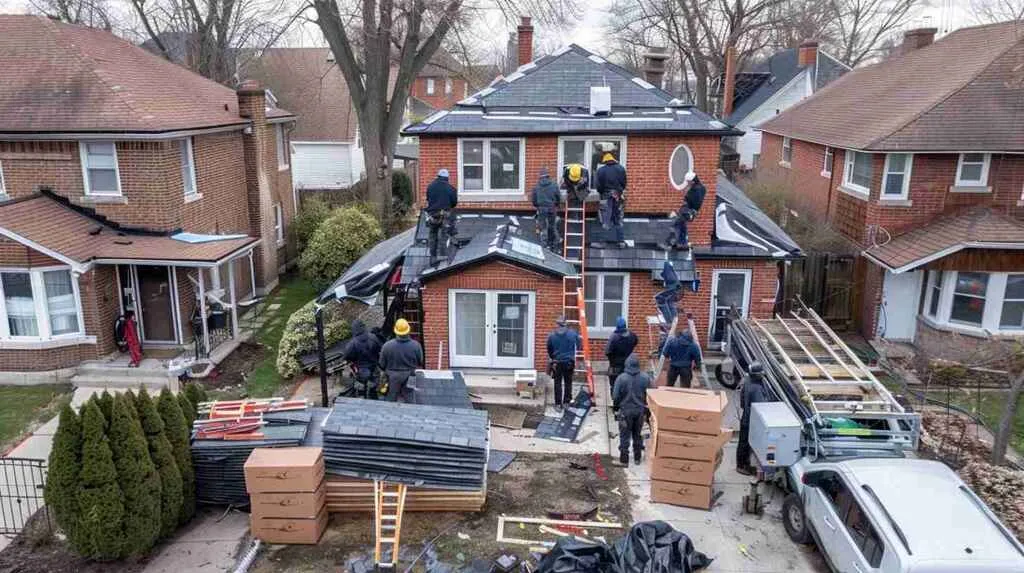
From the moment I pop the ladder on your driveway, I’m already mapping your fall hazards in my head the way I used to trace signal lines on a train diagram. Step by step, here’s what you should see on a safe shingle roof job in Queens: ladder tied off at the top and footed at the base, temporary anchors drilled into framing at strategic spots across the roof, full-body harnesses on every worker with shock-absorbing lanyards sized for your roof height, roof brackets or guardrails along steep pitches and eaves, and a debris control plan so bundles and tear-off don’t land on someone walking past your driveway. There was a November job in Bayside-cold drizzle, that miserable gray that seeps into your bones-where a cheaper contractor had started a shingle tear‑off with no guardrails or tie‑offs because they “had to beat the rain.” One helper slipped on wet felt and slid off the eave, only saved by a stack of plywood they’d leaned against the house. When I was called in the next week to finish the roof, the homeowner and I stood in the driveway at 7 a.m. while I walked her through a real fall protection plan and she admitted the quote she chose wasn’t actually the cheapest once she thought about hospital bills. Queens’ quick weather changes-Bayside wind off the water, Long Island Sound moisture rolling in, sudden afternoon thunderstorms-make skipping gear even more dangerous, and any roofer who doesn’t adjust the plan for local conditions isn’t paying attention.
Core Fall Protection Items Every Queens Shingle Roof Job Should Include
-
✓
Roof-rated full-body harness for every worker on the slope -
✓
OSHA-compliant lifelines and shock-absorbing lanyards sized for roof height -
✓
Permanent or temporary roof anchors rated for fall arrest, properly fastened into framing -
✓
Secured extension ladder (3 ft above eave, tied off at the top) -
✓
Roof brackets or guardrails on steeper pitches and along eaves -
✓
Debris control plan (chutes, tarps, or designated drop zones away from walkways)
DIY vs. Pro: Who Should Be on the Roof?
I’m going to be blunt: if your roofer shows up without harnesses and anchors, they’re gambling with somebody’s spine, maybe yours. The contrast between a trained, fully equipped crew and a DIY homeowner in sneakers on a dusty 6/12 shingle roof isn’t subtle-it’s the difference between a mapped-out safety system and hoping gravity takes the day off. Most homeowners in Queens are better off staying on the ground, and if they absolutely insist on DIY, they must at least invest in temporary anchors, real harnesses rated for fall arrest, and some basic training on how to use them without becoming a statistic. And here’s the thing nobody talks about: hiring a roofer is also choosing how much risk exists above your driveway, because if someone falls on your property, you’re part of that story whether you like it or not.
How We Map and Secure Your Shingle Roof Step by Step
Here’s the question I always ask my customers: who’s on the hook if someone goes over the edge-morally and financially? Once that sinks in, I walk them through my specific safety process on a Queens shingle roof: inspection from the ground to spot power lines, weak overhangs, and tight side yards; a quick look in the attic to confirm where solid framing sits for anchors; then I draw a top-down roof map on scrap paper, marking ridges, valleys, dormers, skylights, and planned anchor points like stops on a subway line. About five years ago in Jackson Heights, we were swapping out an old three‑tab shingle roof in the middle of a windy October evening under work lights because rain was coming. A gust lifted a bundle right out of a new guy’s arms and almost turned him into a kite-he wasn’t clipped in correctly; the lanyard was too long. After we secured everything and finished, I made everyone stay another half hour while I re‑trained them on harness adjustment and anchor placement. I still tell that story every time someone complains that proper fall gear “takes too long.” And here’s an insider tip: homeowners should ask, “Can you show me on paper where your anchors and lifelines will go?” If a roofer can’t sketch that in two minutes, they don’t really have a fall protection plan-they’re winging it and hoping nothing goes wrong.
Now, tie that to how this transit-map mindset translates into a predictable sequence on the roof itself: safe access via a tied-off ladder, install anchors into solid framing at the mapped spots, clip in before moving past the eave, then tear-off and re-shingle within the protected zones. On a 6/12 pitch in Woodside under fall leaves, or a steeper 7/12 colonial in Flushing with a long ridge, the plan might change details-more anchors on longer runs, extra brackets over walkways, different debris chutes depending on driveway layout-but the logic of mapping routes, choke points, and do-not-enter zones stays exactly the same. Every roof gets treated like a train line: you know where the safe stops are, where the track switches, and which zones are off-limits until conditions change.
Rosa’s Shingle Roof Fall Protection Game Plan in Queens
| Queens Roof Scenario | Typical Pitch/Height | Key Hazards | Fall Protection Add-Ons |
|---|---|---|---|
| Two-story colonial, standard gable | 6/12 pitch, 22 ft to ground | Loose granules, leaf debris in valleys, power lines near eave | Ridge and mid-slope anchors, ladder stabilizer, debris chute away from driveway |
| Attached house with shared driveway | 5/12 pitch, 18 ft to pavement | Narrow side yard, neighbor walkway below, chimney creating trip point | Perimeter guardrails along shared side, extra anchors near chimney, controlled debris zone |
| Cape Cod with dormers | 7/12 main, 9/12 dormer faces, 24 ft | Steep dormer pitches, multiple valleys, tight access between dormers | Dormer-specific anchors, roof brackets on steeper sections, restricted work zones until fully tied off |
| Flat-to-pitch transition (row house) | 4/12 rear, flat front parapet, 20 ft | Transition edge from flat to slope, parapet edge drop, frequent pedestrian traffic below | Parapet guardrails, transition-zone anchors, street-side barricades and signage to protect pedestrians |
Deciding If Your Roofer Takes Fall Safety Seriously
Think of your roof like an icy subway platform: you might stay upright by luck, but nobody smart relies on luck twice. As the homeowner, you’re effectively the station manager deciding which crew is allowed on that platform, and that decision shapes how much risk exists above your driveway and family. A serious roofer will welcome questions about anchors, harnesses, insurance, and written plans-they’ll walk you through the answers the same way I sketch roof maps on scrap paper. A risky one will brush those questions off as “extra” or tell you they’ve “been doing this for years” without gear, which is just code for “I’ve been lucky for years and I’m gambling that streak holds.” Treat fall protection questions as a basic pre-screen before you even look at a quote, because the cheapest bid means nothing if it lands someone in the hospital.
Questions to Ask Before Hiring a Shingle Roofer in Queens, NY
-
☑
“Can you show proof of current New York State license and liability/workers’ comp insurance?” -
☑
“What specific fall protection gear will your crew use on my shingle roof?” -
☑
“Where will your anchors and lifelines be installed, and how will you protect my gutters and siding?” -
☑
“Do you have a written fall protection plan for jobs like mine in Queens?” -
☑
“How do you secure the ladder and control debris so nobody gets hit walking by?” -
☑
“Who supervises safety on-site, and how many years of roofing experience do they have in Queens neighborhoods like mine?”
Why Queens Homeowners Hire Shingle Masters for Safe Shingle Roof Work
Common Questions About Shingle Roof Fall Protection in Queens
I still remember a Saturday in Flushing when a homeowner asked me, “Do we really need all that gear just to replace some shingles?” The short answer: yes-but the real answer is in understanding why, and that’s what the questions below clear up. These are the biggest myths and confusions Queens homeowners have about shingle roof fall protection, cost, and who’s responsible when something goes wrong.
▸
Is fall protection really required for a simple shingle repair on my two-story Queens home?
▸
Does proper fall protection make my roofing project in Queens more expensive?
▸
Can I stay home while you’re working on my shingle roof, or is it safer to leave?
▸
What happens if it starts raining or gets too windy during my shingle roof replacement?
▸
Are those temporary roof anchors going to damage my shingles or roof framing?
▸
Does my homeowner’s insurance care whether my roofer used fall protection?
| Myth | Fact |
|---|---|
| “My roof isn’t steep enough to need fall protection.” | Any pitch above 4/12 is steep enough to slide on, especially when wet or covered in loose granules. Most Queens shingle roofs are 5/12 to 7/12-definitely steep enough to require harnesses and anchors. |
| “Real roofers don’t need safety gear; they just know how to walk carefully.” | Even experienced roofers slip-weather changes, materials shift, and fatigue sets in. Professional crews use fall protection because they’re experienced, not in spite of it. |
| “Harnesses and anchors slow the job down and cost me more.” | Proper setup adds maybe an hour to a typical job-nothing compared to the delays from an injury or the cost of a lawsuit. Safety actually speeds things up by preventing accidents that shut work down entirely. |
| “If I hire a contractor, I’m not responsible for their safety.” | While a licensed, insured contractor handles worker safety legally, accidents on your property can still affect your homeowner’s insurance and liability. Hiring a safety-focused roofer protects you too. |
Every Queens shingle roof can be as organized and safe as a well-run train line when fall protection is built into the plan from the start-routes mapped, anchor stations marked, and everyone clipped in before they step past the eave. Call Shingle Masters for a free, safety-first shingle roofing quote in Queens, NY, where our team will map out hazards, anchors, and routes before a single shingle comes off, because the only acceptable number of falls on your roof is zero.