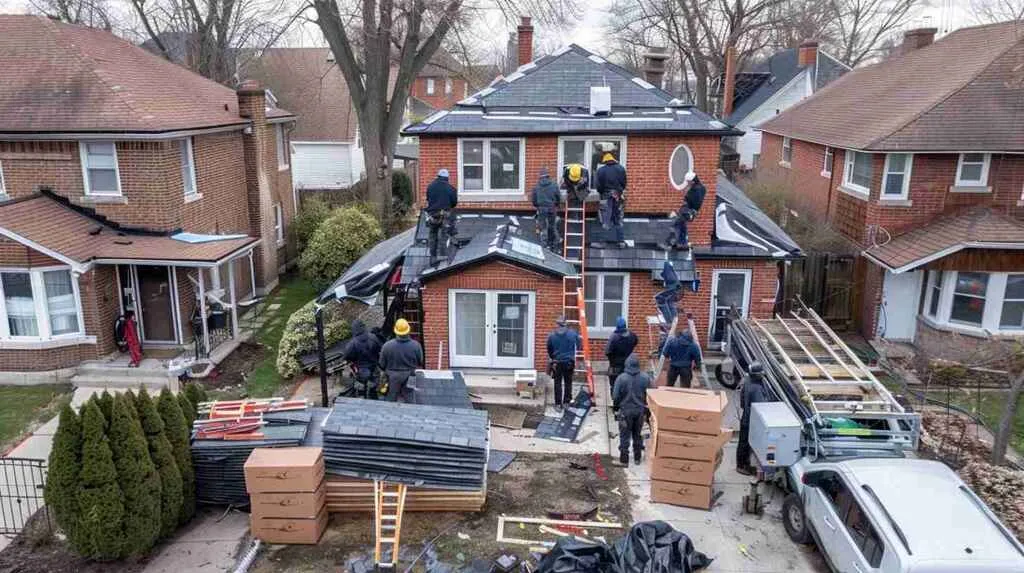
Shingle Roof Expansion Joint Queens NY – Where Used and Why | Free Quotes
Knees, elbows, knuckles – every joint in your body lets bones move without breaking, and your roof is no different. Most Queens shingle roofs that leak at “mystery seams” between buildings are missing a proper shingle roof expansion joint, and here’s what nobody tells you: it’s not an upgrade or an optional detail. It’s a movement joint the roof physically needs to survive, and without it, those buildings will pull apart every time the temperature swings or they settle at different rates.
Where Shingle Roof Expansion Joints Belong on Queens Homes
On a typical block in Elmhurst with those long runs of attached two-families, the first thing I look for is where one building stops breathing and the next one starts. The roofs might look like one continuous shingle field, but underneath are two separate structures – built at different times, on different foundations, moving and settling in different directions. When roofers run shingles straight across that seam without cutting in a proper shingle roof expansion joint, they’ve just built a leak waiting to happen. I don’t say this to scare you; I say it because I’ve opened up those seams dozens of times and watched water tracking exactly where two buildings were trying to pull apart and couldn’t because someone “saved money” by skipping the joint.
One January evening around 6 PM in Ridgewood, I was standing on a two-family house roof in 18-degree weather with this older Polish landlord, and we watched the shingle roof expansion joint literally “breathe” as the temp dropped. You could see the metal cover pop a little and the shingles flex at the joint between his house and the attached neighbor’s. He’d had three leaks over five years because every roofer just shingled straight across that shared wall. Once he saw that movement with his own eyes, he finally understood why I insisted on cutting a proper expansion joint and installing a flexible detail instead of just “another layer.” It wasn’t about selling him something fancy – it was about showing him that those two buildings wanted to move separately, and the roof needed a hinge between them to let that happen safely.
My blunt take? Any shingle roof that bridges two structures without a dedicated expansion detail is a built-in failure. You won’t see it fail immediately, but over time – through temperature cycles, freeze-thaw, settlement – stress builds up until something rips. On Queens row houses and attached two-families, look for hairline cracks running vertically along the seam between buildings, old caulk that’s separated and turned black, or shingles that look slightly rippled or buckled right at that line. If you see those signs, you’re looking at a roof that’s been fighting itself because it has no place to move.
Do you actually need a shingle roof expansion joint?
Start: Do you have a shingle roof where your house physically touches or almost touches another structure?
Yes → Is there a visible seam, change in height, or different siding/brick pattern right under the shingles?
• Yes → Do you see a metal cap, raised ridge, or flexible-looking cover running along that change?
• Yes → You probably have an expansion joint; if you still have leaks, it may be failing or poorly detailed → Schedule an inspection.
• No → You likely need a new shingle roof expansion joint cut in → Plan on a corrective install.
• No → Is there any area where your shingle roof ties into a taller or older wall (like an addition into an older house)?
• Yes → You may need a movement detail or expansion joint at that connection → Have it evaluated.
• No → A formal expansion joint may not be required, but you still need proper flashing and ventilation → General roof check recommended.
No → Detached house with no connections: A classic expansion joint is less common, but movement details around ridges and valleys still matter → Focus on overall roof health.
Quick facts about expansion joints on Queens shingle roofs
- Typical locations: Shared party walls, old-to-new additions, changes in roof height.
- Primary job: Let two structures move independently so shingles and flashing don’t tear.
- Common leak sign: Stains on top-floor ceilings or walls right at the building seam.
- Typical inspection time: 30-60 minutes to evaluate seams and movement points on a standard Queens two-family.
Why These Joints Stop Leaks: Movement, Not Just Shingles
Here’s my honest take: if your roofer pretends your roof doesn’t move, you’re already paying for a future leak. Shingles expand and contract with temperature – on a 95-degree summer day in Flushing that dark asphalt can hit 160 degrees, and on a 20-degree January night it shrinks back. Add to that the fact that older brick buildings and newer wood-framed additions respond differently to Queens freeze-thaw cycles, and you’ve got two systems pulling in opposite directions every single day. The shingle roof expansion joint isn’t about adding more shingles or another layer of tar – it’s about giving that movement a controlled place to happen so the roof doesn’t tear itself apart trying to stay rigid. Think of it this way: your roof is a machine with moving parts, and the expansion joint is the bearing that lets those parts slide safely instead of binding up and cracking.
In 2017, we did a big shingle roof over a small private school addition in Flushing where the new roof tied into a 1950s brick building. First contractor skipped a proper expansion detail and just jammed shingles right into the old masonry. A year later I got a panicked call on a rainy Saturday morning – water was running down the classroom wall, right at the seam. I opened up the area and you could see the stress cracks where the two buildings were pulling in different directions. We ripped that whole section and built a dedicated shingle roof expansion joint, and I had the principal run her hand over the flexible cap so she could “feel” how it would move instead of tear. She got it immediately – once you understand the roof as a breathing, moving system, you see why trying to lock it all together solid is asking for trouble.
| Myth | Fact |
|---|---|
| You only need an expansion joint on very long roofs or commercial buildings. | Any place where two structures meet – even a 10-foot-wide addition – can develop enough movement stress to crack shingles and leak if there’s no joint. |
| Extra caulk or roof cement can seal a moving seam just fine. | Caulk and cement are rigid; they crack as soon as the buildings move. A proper joint uses flexible membranes and caps designed to stretch and slide. |
| If the roof isn’t leaking right now, there’s no movement problem. | Movement stress builds up slowly over seasons and years; by the time you see a leak, significant damage may already exist in the deck and framing. |
| An expansion joint is the same as regular roof flashing. | Standard flashing is static; expansion joints are engineered details with slip planes, soft backing, and flexible caps specifically for movement. |
| Adding more shingles or metal over a seam will stop leaks permanently. | If you strap down a moving joint with rigid material, you just move the problem somewhere else – usually into a bigger, more expensive tear later on. |
| Movement Source | Where You See It | What It Looks Like | What a Proper Joint Does |
|---|---|---|---|
| Daily temperature swings | Shingle field near shared wall | Buckled shingles, popped nails, hairline cracks | Lets shingles slide slightly under a capped joint instead of buckling. |
| Old vs new construction settling | Where addition meets original house | Step cracks in interior plaster, seam leaks after heavy rain | Creates a controlled “hinge” line so movement happens in the joint, not the ceiling. |
| Wind uplift along roof edges | Perimeter at party walls | Whistling, flapping, loosened flashing | Ties the cap and flashing into both structures while allowing minor flex. |
| Freeze-thaw cycles | Brick parapets and coping stones | Spalled brick, open mortar joints, split sealant | Decouples the shingle layer from rigid masonry so cracks don’t telegraph into the roof. |
How We Install and Repair Shingle Roof Expansion Joints in Queens
Think of an expansion joint as the elbow in your arm: if you try to make your roof one stiff bone from front to back, something’s going to snap when it bends. We install shingle roof expansion joints by carefully cutting the roof at the movement line, building a backing structure that can handle the stress, layering in flexible membranes and properly fastened caps, and then weaving the shingles back in so the whole assembly sheds water cleanly while still letting each side of the roof “breathe” separately. Here’s the insider tip nobody tells you: don’t let anyone just caulk or cement over a moving seam. That’s not a repair – that’s welding together a hinge that’s supposed to flex, and you’re just building pressure until something rips open, usually during the worst rainstorm or freeze-thaw cycle Queens can throw at you.
One of the weirdest was a late-summer night job in Astoria on a mixed-use building – deli downstairs, apartments upstairs, roof half shingle, half modified bitumen. The owner had slapped a duct across the roof right where the old structure met a newer rear addition; they’d been patching leaks around it for years. It was 10 PM, humid as a sauna, and we were up there with work lights, cutting in a proper expansion joint system that let the shingle side and the flat side move separately. When we finished, I did my usual “machine” demo and told the owner, “This is the hinge your roof should’ve had ten years ago.” He still sends me pictures every winter freeze-thaw cycle bragging that it’s bone dry. That’s what happens when you respect movement instead of fighting it.
Typical process Shingle Masters uses for a shingle roof expansion joint in Queens
- On-roof evaluation: Identify all movement lines-shared walls, height changes, additions, and transitions between roof materials.
- Open-up and diagnose: Carefully strip shingles and underlayment at the suspect seam to see how the structures actually move and where water is tracking.
- Cut or define the joint: Create a controlled gap or soft zone so each side of the roof can move without tearing the other.
- Build the joint assembly: Install backing, flexible membrane, and properly fastened metal or specialty caps sized for Queens’ temperature swings.
- Tie shingles back in: Weave shingles into the joint detail so it sheds water cleanly without looking like a patchwork.
- Water test and walkthrough: Hose-test the area when possible and walk the homeowner through how the new joint lets the roof “breathe” safely.
⚠️ Warning: Slapping cement, extra shingles, or a metal strap straight over a moving seam between buildings can trap stress until something rips open-usually during the worst Queens rainstorms or freeze-thaw cycles. If a contractor suggests you can “save money” by skipping the expansion joint and just “sealing it up,” you’re paying to delay (and usually multiply) the leak, not fix it.
What It Might Cost to Fix That Seam on Your Queens Shingle Roof
$1,500 to $3,200 is a pretty normal range for cutting in a proper shingle roof expansion joint on a typical Queens seam, and here’s how the numbers usually break down. A basic re-detail on a short 5- to 10-foot joint where the existing structure is mostly sound but the joint is leaking might run $750 to $1,400. If we’re building a brand-new expansion joint where shingles were run straight across a shared wall or addition with no detail at all, expect $1,500 to $3,200 for a 10- to 20-foot section. Longer party-wall joints on row houses or full two-family seams, especially if we’re replacing damaged deck underneath, can run $3,000 to $6,500. Complex transitions – say, where a shingle roof meets a flat modified bitumen roof around equipment or a dormer – can hit $3,500 to $7,500 depending on access and how much structural work is hiding under the surface. The exact price depends on roof height, how bad the damage has spread, and whether we can work from one side or need scaffolding, but here’s the truth: catching and fixing the movement joint early is almost always cheaper than chasing ceiling repairs, interior wall damage, and mold remediation later.
Typical price ranges for shingle roof expansion joint work in Queens, NY
| Scenario | Description | Typical Price Range* |
|---|---|---|
| Basic seam re-detail | Short (5-10 ft) joint on a low-slope shingle roof between two attached homes, existing joint in place but leaking. | $750 – $1,400 |
| New expansion joint install | Cutting in a 10-20 ft joint where shingles were run continuously over a shared wall or addition seam. | $1,500 – $3,200 |
| Long party-wall joint rebuild | 20-40 ft joint along a full row-house or two-family party wall, including some deck repair. | $3,000 – $6,500 |
| Complex mixed-roof transition | Joint where shingle roof meets flat or modified bitumen roof, often around ducts or equipment. | $3,500 – $7,500 |
| Emergency leak stabilization | Temporary but smart movement-friendly detail to stop active leaks until full work is scheduled. | $500 – $1,000 |
*Actual costs depend on access, height, structural condition, and how far water damage has spread. These are typical Queens ranges, not formal quotes.
How quickly you should call about a leaking seam
| Call Shingle Masters ASAP | Can Usually Wait a Few Days |
|---|---|
| Active dripping at the ceiling or light fixtures after rain, right where two buildings meet. | Small, faint stain that hasn’t grown over several storms. |
| Visible daylight or a gap where shingles meet a wall or another roof. | Old water marks you’re monitoring but haven’t seen change. |
| Previous patches at a seam have failed more than once. | No interior leaks, but you’ve noticed some rippled shingles near a seam. |
| Water running down interior walls at the junction of old and new construction. | You’re planning a future renovation and want the seam evaluated in advance. |
Before You Call for a Shingle Roof Expansion Joint in Queens
When I sit down with a homeowner, the first question I ask is, “Where does your house connect to something that wasn’t built at the exact same time?” Your roof should be thought of as a living machine with moving parts, and having a few details ready before the visit helps me diagnose the movement problem faster and more accurately. Photos of the seam from the street and from inside near the leak are especially helpful – if I can see both sides of the problem before I climb up, I can usually tell you on the phone whether we’re looking at a simple re-detail or a full corrective joint install.
Checklist for Queens homeowners with a mystery seam leak
-
✅
Note exactly where the interior leak is (center of room, near party wall, under a dormer, etc.). -
✅
Check if the leak lines up with where your house touches a neighbor or an addition outside. -
✅
Take clear photos of the roof seam from the street or backyard, if visible. -
✅
Inside, look for cracks in the ceiling or wall near the leak that might show movement, not just moisture. -
✅
Write down how long the leak has been happening and whether it’s worse in heavy wind-driven rain. -
✅
If you’ve had prior “patches” done, gather any invoices or notes to show what was attempted.
Common questions about shingle roof expansion joints in Queens, NY
Do all Queens shingle roofs need an expansion joint?
No. Detached homes with simple, single-age structures often don’t need a formal expansion joint, but every roof needs details that respect movement-proper flashing, ventilation, and room for materials to expand and contract. Expansion joints are most critical where two structures or roof systems meet.
Can you add an expansion joint without replacing my whole roof?
Often, yes. We can surgically open a section around the problem seam, build the joint, and then tie new shingles back into your existing roof. If the field shingles are very old or brittle, we may recommend a larger section replacement to avoid breakage.
How long does a properly built expansion joint last?
When it’s detailed correctly and inspected with the rest of the roof, the joint should last the life of a good shingle roof-20+ years-though sealants and some components may need maintenance along the way.
Will an expansion joint look ugly or obvious from the street?
No. A well-designed joint is low-profile and aligned with natural lines in the roof. Our goal is for your neighbors to see a clean, intentional detail, not a Frankenstein patch.
Do you handle both shingle and flat roof transitions?
Yes. Many Queens buildings mix shingle fronts with flat or modified bitumen rears. We design expansion and movement joints that let each system do its job without tearing the other apart.
Why Queens homeowners call Shingle Masters for tricky seams
- 19+ years solving expansion and movement issues on Queens roofs.
- Specialty: Shingle roof expansion joints on attached homes, additions, and mixed-use buildings.
- Fully licensed & insured in New York City.
- Local focus: Queens neighborhoods like Elmhurst, Ridgewood, Flushing, Astoria, Jamaica, and beyond.
- Free on-roof quotes for shingle roof expansion joint inspections and repairs.
If you can picture your roof trying to move at those seams – expanding in summer heat, contracting in January cold, settling differently on either side of an addition or party wall – you can see why a shingle roof expansion joint isn’t just a nice-to-have detail. It’s the hinge the whole system needs to stay watertight and structurally sound. Call Shingle Masters today for a free on-roof expansion joint inspection and quote anywhere in Queens, NY, or schedule a visit if you’re already seeing stains, cracks, or mystery drips along those connections – we’ll show you exactly where your roof is trying to move and how to let it do that safely.