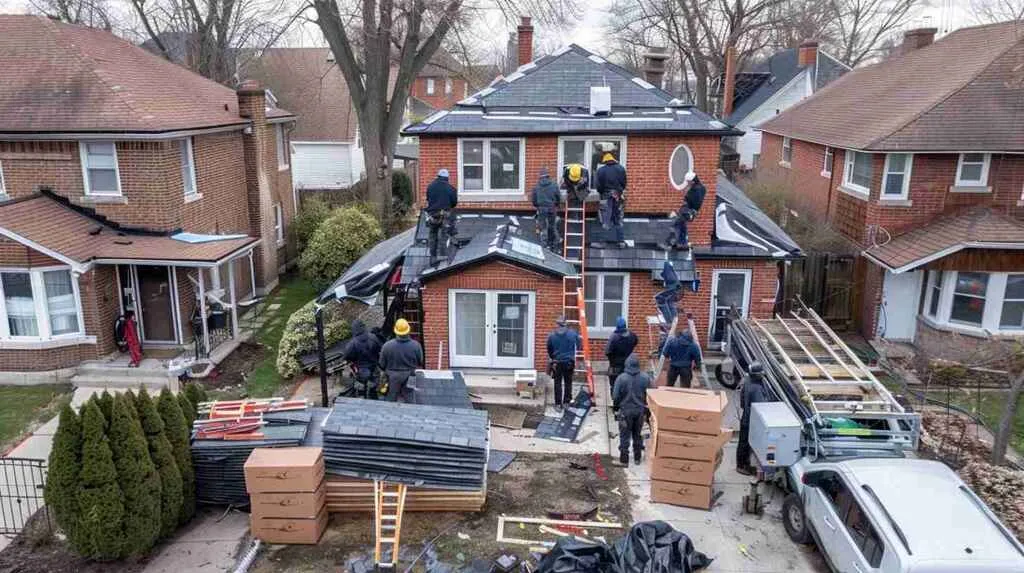
Roof Shingle Underlayment Queens NY – What Goes Under Shingles | Call Today
Underneath every roof in Queens sits a layer that decides whether your next storm ends with a quiet evening or a panicked call to your insurance company. I’m Eric “Numbers” Delgado-17 years in roofing after walking away from financial analysis on Wall Street-and I’ll tell you what almost nobody else says up front: the underlayment under your shingles matters more than the shingles themselves when wind-driven rain comes sideways off the bay. This isn’t a sales pitch; it’s a straight-up breakdown of what actually protects your ceiling, written by the guy other roofers in Queens call when they can’t figure out which underlayment to use.
What Really Protects Your Queens Roof Under the Shingles
Underneath your shingles, there’s a layer that’s basically an insurance policy against the stuff that keeps homeowners awake during Nor’easters: sideways rain, ice dams, and those summer downpours that hit Queens like someone turned a faucet upside down. That layer is your roof shingle underlayment, and here’s my blunt opinion after nearly two decades on ladders: I’d rather see a basic architectural shingle over excellent underlayment than a designer shingle over cheap, badly installed felt any day of the week. The underlayment is what I care about when I write an estimate, not what color your roof is going to be-because I know which one actually decides whether you stay dry when the next Henri-level storm rolls through.
On a typical two-family in Queens with a 1,200-square-foot roof, the underlayment is doing more work than the shingles on half the stormy days of the year. Think of it this way: shingles shed water when everything goes right, but underlayment is the backup plan when wind gets under a tab, when an ice dam forms at your eave, or when a summer thunderstorm hits and rain comes in horizontal. In neighborhoods all over Queens-from Jackson Heights to Bayside-that backup plan is what earns its “storm dividends.” One August in Jackson Heights, I watched a homeowner’s big-box felt underlayment literally curl in 94-degree heat before we even nailed it down. I stopped the job, swapped it for synthetic from my truck, and two weeks later Hurricane Henri proved the point: his neighbor’s old felt roof leaked; his didn’t take a drop.
| Underlayment Type | Typical Use in Queens, NY | Strengths | Weak Spots/Risks | How I Actually Use It on Shingle Jobs |
|---|---|---|---|---|
| 15# Asphalt Felt | Code-minimum budget jobs, garages, sheds-rarely on occupied homes anymore | Very cheap, readily available, meets bare NYC code | Tears easily in wind, buckles in heat, short service life, absorbs water if exposed, wrinkles and waves under shingles | Honestly? I don’t install this on residential roofs in Queens unless a homeowner demands it in writing to save a few hundred bucks, and even then I make them sign a waiver about the risk. |
| Synthetic Underlayment | My standard spec for full roof coverage on almost all Queens shingle jobs | Tear-resistant, doesn’t buckle in heat, lays flat, long exposure rating if job gets delayed, excellent secondary water barrier | Costs more than felt (but not dramatically), slippery when wet (safety concern during install), varies in quality by brand | This is my default across the entire roof deck. It stays flat, handles Queens heat waves without curling, and if a job sits exposed for a few days waiting on shingles, it holds up where felt would disintegrate. |
| Ice & Water Shield (Peel-and-Stick) | Eaves, valleys, penetrations, low-slope sections, any vulnerable transition-think of it as the ‘storm insurance’ layer | Self-sealing around nails, waterproof membrane, stops ice dam leaks cold, bonds directly to deck, handles wind-driven rain where regular underlayment fails | Most expensive underlayment option, hard to remove if you ever need deck repairs, can trap moisture if deck isn’t dry during install | I use this strategically: minimum two feet up from every eave, full coverage in all valleys, around every chimney and vent, and on any low-pitch section (like over porches in Bayside). It’s not cheap, but it stops leaks where synthetic alone won’t. |
Queens Code Minimum vs. Real-World Storm Protection
When I sit down at your kitchen table, I usually start with one question: “Do you want the minimum the code allows, or the protection Queens weather actually demands?” Because here’s the thing-NYC building code sets a floor, not a ceiling, and that floor was written for the entire city, not your specific block in Bayside where wind comes off the water and ice dams form on shallow-pitch porches every January. Back in 2016, a retired teacher in Bayside called me after a contractor had “finished” her new roof the month before. Cold November morning, I climbed up and found they’d skipped ice and water shield completely over her shallow-pitch back porch. I proved it with a utility knife-cut a neat inspection window, showed her bare wood under the shingles-and that job turned into a full tear-off and re-do. We laid proper ice and water along the eaves and valleys, and she’s called me every major storm since just to tell me, “Eric, still dry!”
So what does Queens code basically expect? Underlayment across the entire roof deck and ice and water shield in certain high-risk zones-mainly eaves and valleys on standard-pitch roofs. That’s fine. It’ll keep you out of violation. Now, translate that into real-world risk: code minimum is like having the bare-bones health insurance policy-it covers you if something catastrophic happens, but you’re still exposed to a lot of smaller claims along the way. Step one notch above minimum-more ice and water shield at transitions, higher-grade synthetic across the field, full coverage on low-pitch sections-and you sharply cut your leak risk. I think of it the same way I used to rebalance investment portfolios before a recession: reduce your “risk exposure” in the places where storms actually hit hardest.
Warning: Skipping Ice & Water Shield on Low-Slope Sections
In neighborhoods like Bayside, Howard Beach, and other coastal or low-lying parts of Queens, skipping ice and water shield on low-pitch roofs and over enclosed porches is one of the fastest ways to end up with hidden rot and stained ceilings within a few winters. Code might not always require it on these sections, but Queens weather sure demands it. If your roof has any section under a 4/12 pitch-common on porch overhangs, attached garages, and some ranch-style homes-and your contractor isn’t spec’ing full ice and water coverage there, you’re sitting on a hidden liability waiting for the next big storm.
The Underlayment Installation Mistakes That Cause Leaks
I still remember peeling back shingles on a Friday morning in Astoria and seeing underlayment stapled like wrapping paper-no wonder that ceiling was stained. Installation matters as much as material choice, maybe more, because even the best synthetic underlayment turns into a funnel for water if it’s lapped backwards or fastened wrong. The worst failure I’ve seen was in Rosedale at 10 p.m. during a thunderstorm: young couple called panicking because water was coming through a light fixture in the nursery. When I got there with my headlamp, I found the new roof had underlayment lapped backwards-water was basically being funneled under the shingles and straight into their home. I traced the drips like a crime scene, showed them the reverse laps, and we threw down emergency peel-and-stick patches under a tarp until morning. The next week we stripped half that roof, re-did the underlayment correctly, and their electrician fixed the fixture before they brought the baby home. Here’s my insider tip for every Queens homeowner hiring a roofer: ask your contractor to show you one exposed underlayment lap before shingles cover it, so you can see the nail pattern and lap direction with your own eyes. Reputable roofers won’t mind this at all-the sketchy ones will make excuses.
One bad detail-a $2 shortcut in how underlayment is fastened or lapped-can turn into a $20,000 interior repair when the next Nor’easter rolls through.
Now, translate that into real-world risk by knowing the top three installation red flags you can actually ask about before work starts. First: fasteners. Some underlayments can be stapled, others require nails or cap nails in high-wind zones-and in Queens, especially near the water, wind matters. If your roofer is stapling synthetic underlayment on a windy exposure in Rockaway, that’s a problem. Second: proper overlaps and direction. Underlayment laps should shed water down the roof, never funnel it sideways or-God forbid-backwards. Each row overlaps the one below it, and side laps need to be wide enough (usually six inches minimum). Third: full coverage vs. patchy. I’ve seen contractors skip underlayment entirely in small sections “because the deck looked good” or because they ran short on a Friday and figured they’d finish Monday. Every gap, every shortcut, is a hidden liability sitting on your roof waiting for the next storm to find it.
Installation Red Flags to Ask Your Roofing Contractor About Before They Start
Ask: “What type of fasteners are you using for the underlayment, and how far apart?” Look for cap nails or proper staples at manufacturer-spec intervals, not random placement.
Red flag: Contractor says “we just staple it down real quick” with no mention of wind rating, fastener pattern, or manufacturer requirements.
Ask: “Can I see a sample of how you’ll overlap the underlayment rows-which direction and how much overlap?” Should be top-over-bottom (shingle style) with minimum 6″ side laps and proper head laps per product.
Red flag: Vague answer like “we’ve been doing it this way for years” or inability to show you lapping details in the manufacturer’s installation guide.
Ask: “Will you cover 100% of the roof deck, and can I inspect it before shingles go on?” Answer should be yes, with no hesitation.
Red flag: Defensive response or “we’ll cover it as we go, you won’t need to see it”-reputable contractors in Queens have nothing to hide and will welcome your inspection.
When to Call a Queens Shingle Roofer About Possible Underlayment Issues
Call Shingle Masters ASAP
- Water stains on ceiling appeared during or right after a storm
- You can see daylight or sky through gaps in your roof deck from the attic
- New roof installed within past year and you’re already seeing leaks
- Contractor just “finished” but you can see wrinkled, loose, or patchy underlayment from the ground or a window
Can Usually Schedule an Inspection Within a Week
- Roof is 15+ years old and you’re planning replacement-want underlayment advice now
- Getting estimates and want a second opinion on what underlayment another contractor proposed
- Attic inspection shows old felt that’s deteriorated or has visible gaps
- Buying a home in Queens and roof inspection flagged possible underlayment concerns
Choosing the Right Underlayment Package for Your Queens Home
Risk vs. Cost: Your Roof’s ‘Portfolio Mix’
Think of cheap felt underlayment like a discount umbrella in a Nor’easter-technically it’s an umbrella, but you already know how that story ends. Here’s how I lay out underlayment choices for Queens homeowners, using the same framework I used to use for investment portfolios on Wall Street: you’re picking a risk-return mix, not just a product. Bare minimum (15# felt across the deck, code-minimum ice and water at eaves) is high risk, low cost-you’ll pass inspection, but you’re “overexposed” to storm damage and you’re betting nothing goes wrong for 20 years. Balanced (synthetic across the full deck, strategic ice and water at eaves, valleys, and penetrations) is moderate cost with a big drop in risk-this is where most smart homeowners land because the extra few hundred bucks pays “storm dividends” every time wind-driven rain hits. Storm fortress (premium synthetic, extended ice and water coverage on low-pitch sections and the first six feet of every slope, full protection around all transitions) costs more up front but delivers the lowest risk, and it’s what I recommend for exposed homes near the water in Rockaway, Broad Channel, or waterfront Bayside. My personal opinion after 17 years? The balanced approach-full synthetic plus strategic ice and water-is the smartest risk-return play for most Queens roofs, because it eliminates the majority of hidden liabilities without blowing your budget on over-engineering.
What I Recommend for Most Queens Shingle Roofs
On a typical Queens shingle job-let’s say a colonial in Bayside or a two-family in Jackson Heights-I usually install full synthetic underlayment over the entire roof deck, then layer ice and water shield at the eaves (minimum two feet up from the edge), in all valleys (full length), around every penetration (chimneys, vents, skylights), and on any section with a pitch below 4/12. That setup handles Nor’easters, summer downpours, ice dams, and the occasional tree branch without breaking a sweat. Now, I adjust the mix based on your specific exposure: a Jackson Heights walk-up with a steep pitch and good tree cover might not need as much ice and water as a Bayside colonial three blocks from the bay where wind comes off the water every storm, and a home in Rockaway facing the ocean gets the full “storm fortress” treatment because salt air and hurricane-force gusts aren’t theoretical-they’re annual. But no matter what, the underlayment is the core “insurance layer” I’m designing first, then we pick shingles to match your budget and style.
Example Underlayment Packages & Ballpark Added Cost
(Typical 1,200 sq. ft. Queens Shingle Roof)
| Scenario | Underlayment Setup | Best For | Approx. Added Cost vs. Basic Felt | Risk Level in Heavy Queens Storms |
|---|---|---|---|---|
| Code Minimum | 15# felt across deck, 2 ft. ice & water at eaves only | Absolute tightest budget, garage, shed-rarely worth it on a home you live in | Baseline ($0) | High Risk ⚠️ |
| Basic Upgrade | Synthetic across deck, 2 ft. ice & water at eaves, 3 ft. in valleys | Standard-pitch roofs in moderate exposure (Rego Park, Forest Hills, inland areas) | +$400-$650 | Moderate Risk ⚡ |
| Balanced (Recommended) | Synthetic across deck, 3 ft. ice & water at eaves, full valleys, all penetrations, any low-pitch sections | Most Queens homes-best risk-return balance for typical exposure and weather | +$700-$1,100 | Low Risk ✓ |
| Enhanced Protection | Premium synthetic, 4-6 ft. ice & water at eaves, full valleys, double coverage at transitions, extended coverage over porches | Higher-exposure neighborhoods (near water, high wind), homes with history of ice dams or past leaks | +$1,200-$1,800 | Very Low Risk ✓✓ |
| Storm Fortress | Premium synthetic, ice & water over first 6 ft. of all slopes, full coverage on any pitch under 4/12, triple coverage at critical flashing points | Waterfront homes (Rockaway, Broad Channel, Bayside bay-side), hurricane-zone exposure, maximum peace of mind | +$2,000-$2,800 | Minimal Risk ✓✓✓ |
Note: Costs are approximate material + labor premiums over baseline felt on a typical 1,200 sq. ft. gable roof in Queens. Your actual cost will vary based on roof complexity, pitch, number of penetrations, and current material pricing. These figures show you the incremental investment to reduce leak risk-not the total roof price.
Simple Decision Helper: Which Underlayment Setup Should You Ask For?
START HERE → Is your home exposed to high winds or near water?
(Rockaways, Broad Channel, Bayside waterfront, open bay exposure)
✅ YES → Go to BRANCH A
❌ NO → Go to BRANCH B
BRANCH A: Does your roof have any low-pitch sections, porches, or valleys that catch debris?
✅ YES → Recommend: Enhanced Protection or Storm Fortress
You need premium synthetic + extended ice & water on low-pitch areas and heavy coverage at eaves/valleys to handle wind-driven rain and ice dams.
❌ NO → Recommend: Enhanced Protection
Even with standard pitch, high wind exposure calls for premium synthetic and 4-6 ft. ice & water at eaves, plus full valley coverage.
BRANCH B: Have you had past leaks, ice dams, or insurance claims on this roof?
✅ YES → Recommend: Balanced or Enhanced Protection
Past problems mean hidden vulnerabilities. Upgrade underlayment to break the leak cycle-synthetic + strategic ice & water at known trouble spots.
❌ NO → Recommend: Balanced (Standard for Most Queens Homes)
Moderate inland exposure, no history of trouble-synthetic across the deck + ice & water at eaves, valleys, and penetrations gives you excellent protection at smart cost.
💡 Still Not Sure?
Call Shingle Masters and describe your roof, neighborhood, and any past issues. We’ll walk you through the exact underlayment “portfolio mix” that makes sense for your home and budget.
Before You Call for Underlayment or Shingle Work in Queens
Here’s the truth nobody advertises: shingles are your roof’s face, but the underlayment is its immune system. Every time a storm rolls through Queens, the underlayment is what keeps water off your ceiling when shingles get compromised. Think like an investor: spend a little more now on the right underlayment setup and you avoid big “claims” later-water damage, mold remediation, emergency repairs at 10 p.m. When you call Shingle Masters, we’ll walk you through the exact underlayment spec on paper before any shingles go on, because that’s the layer that actually decides whether you stay dry.
Quick Prep List Before You Call Shingle Masters About Roof Shingle Underlayment
Take photos of your existing roof from the ground – front, back, any visible damage, and close-ups of problem areas if you can safely get them. We can often spot underlayment clues from shingle condition.
Note any leak locations and when they happen – ceiling stains, wet spots in the attic, leaks during specific weather (heavy rain, ice, wind). Patterns tell us where underlayment is likely failing.
Know the age of your current roof – or at least roughly when it was last replaced or repaired. Underlayment degrades over time, and age is a key risk factor.
Check if you have safe attic access – we’ll often want to inspect from below to see the underside of the deck, look for daylight, check insulation, and spot moisture or prior leak damage.
Write down your underlayment questions before the call – it’s easy to forget in the moment. Ask about product brands, coverage areas, fastener type, warranty impact, anything you’re unsure about.
Have your address and a rough idea of your roof size ready – we can often give you a ballpark underlayment cost range over the phone if we know square footage and pitch (or we’ll measure on-site during the estimate).
Why Queens Homeowners Trust Us With Their Underlayment & Shingle Roofs
-
✓
Licensed & insured in NYC – fully compliant with Queens building codes and carrying commercial liability and workers’ comp so you’re protected -
✓
17+ years roofing experience in Queens – we’ve handled every roof type, every weather event, and every underlayment challenge this borough throws at us -
✓
Same- or next-day emergency storm response when possible – if your roof is leaking and underlayment has failed, we prioritize getting you tarped and scheduled fast -
✓
Detailed written underlayment specs on every proposal – brand, type, coverage areas, fastener schedule, all in writing before you sign, so there’s zero confusion about what goes under your shingles -
✓
References available in neighborhoods across Queens – Astoria, Bayside, Jackson Heights, Rosedale, Forest Hills, Rego Park, Howard Beach, Rockaway-we’ve worked on roofs in your neighborhood and homeowners will vouch for us
Common Queens Underlayment & Shingle Questions
How long does roof shingle underlayment last in Queens?
It depends entirely on the type. Cheap 15# felt can start degrading in 5-10 years, especially if it’s ever been exposed to weather during a roof job or if heat and moisture cycle through your attic. Quality synthetic underlayment is typically rated for 20-30 years or longer and will often outlast the shingles above it. Ice and water shield, once installed correctly, lasts the life of the roof. Bottom line: if you’re installing new shingles, always upgrade the underlayment at the same time-don’t leave old, degraded felt under brand-new shingles and expect it to protect you.
Can you re-use old underlayment when replacing shingles in Queens?
Short answer: no. Once underlayment has been nailed, exposed to UV during the original install, and aged under shingles for years, its waterproofing integrity is compromised. Trying to save a few hundred dollars by leaving old felt in place is like putting new tires on a car but keeping the dry-rotted spare-it defeats the whole purpose of the investment. Any reputable Queens roofer will strip old underlayment down to the deck and install fresh product, and that cost should already be baked into your shingle replacement estimate.
If I have a leak, does the whole roof need to be replaced or just the underlayment?
It depends on what’s causing the leak and the age of your roof. If the leak is isolated-say, around a chimney or in one valley-and your shingles are relatively new and in good shape, we can often do a targeted repair: strip that section, replace the underlayment and flashing, and re-shingle just that area. But if your roof is 15+ years old, shingles are worn, and underlayment is degraded across the whole deck, a full replacement is usually the smarter long-term play. I’ll inspect, show you exactly what’s failing, and give you the honest cost-benefit of patch vs. full replacement so you can decide.
Can underlayment be installed in winter in Queens, or do I have to wait until spring?
Yes, underlayment can be installed in winter, but there are limits. Synthetic underlayment can go down in cold weather as long as the deck is dry and temps are above the manufacturer’s minimum (usually around 20-25°F). Ice and water shield is trickier-it’s a peel-and-stick membrane that relies on adhesive, and that adhesive doesn’t bond well in freezing temps; most manufacturers say don’t install below 40°F, though some cold-weather formulas go lower. If you have an emergency leak in January, we can do temporary repairs and plan the full underlayment job for early spring when temps cooperate. Always better to do it right than to rush it in bad conditions.
Does the type of underlayment affect my shingle warranty?
Absolutely. Most shingle manufacturers now require-or at least strongly recommend-specific underlayment types to maintain full warranty coverage, especially for upgraded or “lifetime” shingles. If you install premium shingles over cheap felt that doesn’t meet the manufacturer’s spec, you can void wind-resistance warranties, enhanced coverage, and sometimes even the basic material warranty. When we write your estimate, we’ll match the underlayment to your shingle choice and note which combination keeps your warranty intact. It’s one more reason to put the underlayment spec in writing before any work starts.
Ready to Set Up Your Roof’s Protection the Right Way?
If you want your roof’s “portfolio” set up right-proper shingle underlayment plus the right ice and water shield for Queens storms-call Shingle Masters and let Eric walk you through the exact underlayment plan for your home. No guesswork, no shortcuts, just honest advice and detailed specs in writing before any shingles go on.
📞 Call today for an inspection or quote on roof shingle underlayment and shingle replacement in Queens, NY.