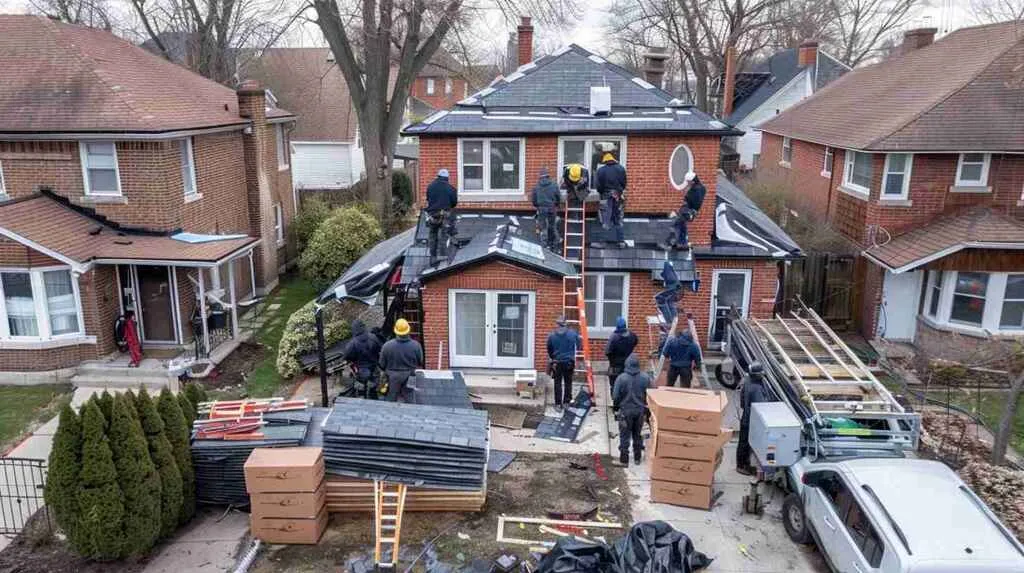
Roof Shingle Overhang Queens NY – How Much Is the Right Amount?
Margin matters-and I’m going to start by telling you the number every Queens homeowner needs to know: your asphalt roof shingle overhang should usually sit right around 3/8″ to 3/4″ past the drip edge-get much longer than that and a good coastal wind can snap your shingles right at the nails. I’m Carmen Rivera, a Queens shingle specialist who’s been obsessed with roof edges for 19 years, and I’m going to show you exactly how that tiny margin along your eaves controls whether your house sheds water cleanly or sucks it into your walls.
The Ideal Roof Shingle Overhang for Queens, NY Homes
I’m going to start by telling you the number every Queens homeowner needs to know: your asphalt roof shingle overhang should usually sit right around 3/8″ to 3/4″ past the drip edge-get much longer than that and a good coastal wind can snap your shingles right at the nails. Think of shingle overhang the same way you’d think about margins on a printed page-if the margin is too narrow, the text (in this case, water) runs off into the binding where it doesn’t belong; if the margin is too wide, the whole layout looks wrong and the page tears easier. I’m strict about keeping overhang in that 3/8″-3/4″ window on Queens roofs, even when homeowners or other contractors like the look of longer edges, because I’ve watched what happens when people get cute with the measurements. I’ve literally sketched this cross-section on pizza box flaps in customers’ driveways until they could see why those fractions of an inch matter.
Here’s the thing: that small margin along your roof edge is what controls whether rainwater drips clean off into your gutters or curls back under the shingles and into your fascia. In Queens, with our mix of coastal storms, Nor’easters that hit sideways, and older roof decks on homes built in the ’40s through ’70s that have sagged and twisted over time, staying in that 3/8″-3/4″ range isn’t a suggestion-it’s the difference between a roof that protects you and one that slowly rots your house from the top down.
| Overhang Length | What It Looks Like | Typical Result in Queens Weather | Risk Level |
|---|---|---|---|
| Less than 3/8″ | Shingles barely reach past the metal drip edge, sometimes sitting flush with fascia | Water curls back under shingles during heavy rain and Nor’easters, soaks fascia, runs into soffit vents during freeze-thaw cycles | HIGH – Water intrusion likely |
| 3/8″ to 3/4″ | Clean, consistent reveal past drip edge, roughly the thickness of your thumb | Water drips cleanly into gutters, wind can’t get under edges, shingles stay secure at nail line even in 40+ mph coastal gusts | LOW – Ideal range |
| 3/4″ to 1-1/4″ | Noticeably long edge, shingles stick out about as far as a smartphone is thick | Wind uplift begins, especially during Nor’easters and summer thunderstorms; edges start to flutter and crack at the nail line | MODERATE – Wind damage risk increases |
| Over 1-1/4″ | Shingles hang way past the edge, visible droop or curl at eaves | Acts as a lever for wind, shingles snap at nails during storms, entire rows can tear off during 50+ mph Nor’easter gusts | VERY HIGH – Structural failure likely |
Quick Facts: Queens Roof Edge Numbers
Before you scroll any further, ask yourself: have you ever actually walked to the curb and looked at how far your shingles stick past the metal edge?
Too Much Overhang: When Extra Coverage Becomes a Wind Lever
Let me be blunt: if your shingles are hanging more than about three‑quarters of an inch past the metal edge, they’re not protective- they’re a lever waiting for the wind to grab. One August afternoon, about 5:30 p.m. right before a thunderstorm, I was on a semi‑attached in Woodhaven where the shingles were hanging almost two inches past the drip edge. The homeowner kept saying, “But it looks like it’s covering more, that has to be better, right?” Ten minutes later the wind kicked up, and we actually watched a whole row of overhanging shingles start to flap and crack at the nail line. That was the first time I used the phrase “too much lip gets ripped” and it stuck with me ever since. Around here in Woodhaven, those long eaves on semi-attached homes catch those late-afternoon thunderstorms and coastal winds perfectly-and if your overhang is acting like a sail, the wind will find it.
Here’s the principle in plain structural terms: when your shingle overhang goes past about 3/4″, it turns into a lever arm. Wind doesn’t just blow over your roof-it gets underneath that extended edge and lifts upward, putting enormous stress right at the nail line where the shingle is fastened to your deck. In a typical Queens Nor’easter with gusts hitting 50 or 60 mph, that leverage multiplies by hundreds of pounds per square foot. I don’t care how pretty it looks or how much “extra coverage” you think you’re getting-too much lip gets ripped, every single time. That’s why I trim back overhangs in Queens even when it looks like “less coverage,” because I’d rather have less shingle doing its job correctly than more shingle waiting to tear off in the next big blow.
Dangers of Overhanging Shingles More Than 3/4″ in Queens
- Wind Uplift & Shingle Failure: Extended overhang acts as a lever during Nor’easters and coastal storms, creating massive upward pressure at the nail line that literally rips shingles off in rows-especially dangerous on exposed eaves facing open streets or water.
- Cracked Shingles at Fasteners: Even if shingles don’t tear completely off, the constant flutter and flex at the extended edge causes hairline cracks right where the nails hold, letting water seep under and starting a slow rot you won’t see until it’s a $15,000 problem.
- Voided Manufacturer Warranty: Most asphalt shingle warranties explicitly state maximum overhang limits (usually 3/4″ to 1″), and if your installer left 2″ of overhang and you file a claim for wind damage, you’re out of luck-the manufacturer will point at installation specs and walk away.
- Accelerated Replacement Timeline: A roof that should last 20-25 years in Queens will need replacement in 12-15 when excessive overhang lets wind batter the edges every storm season, effectively cutting your roof’s useful life in half and costing you an extra $8,000-$12,000 a decade early.
Signs Your Shingle Overhang Is Too Long
Too Little Overhang: How Short Edges Invite Water into Your Walls
On a typical Queens block, especially in places like Maspeth and Ozone Park, I see the same mistake over and over at the eaves: somebody-usually a handyman trying to “fix” ice dams or a crew rushing through a cheap re-roof-cuts the shingles back almost flush with the fascia, leaving basically no overhang at all. I’ll never forget a winter job in College Point where a handyman had tried to “fix” ice dam issues by cutting the shingle overhang back flush with the fascia, no reveal at all. It was 28 degrees, cloudy, and the gutters were packed with slush. Meltwater was running straight behind the fascia and into the soffit vents, and by the time I got there you could smell the wet insulation from the driveway. I ended up showing the owner, on a frosty 2×4, how that missing half inch of overhang was basically a straight invitation for water into the wall. In Queens winters, with our constant freeze-thaw cycles, that’s not just cosmetic-it’s the difference between dry walls and a moldy mess by March.
Here’s what’s happening when you trim back to almost zero reveal: you’re defeating the whole point of the drip edge. Water is supposed to hit the shingle, flow down past that little margin, and drip cleanly off into your gutters-think of it like a subway platform with that metal safety edge where the gap forces water to fall straight down instead of curling back toward the wall. When you cut the shingles flush or leave only 1/8″ or 1/4″, rain doesn’t drip-it clings. Surface tension pulls it back under the edge, it runs along the top of the fascia, finds every crack and seam, and next thing you know your soffit vents are wet, your insulation smells like a basement, and you’ve got paint bubbling on your second-floor bedroom wall. That’s why I insist on that 3/8″-3/4″ reveal as a bare minimum margin-it’s not optional, it’s physics. Want to check your own house right now? Stand in your driveway and look at the roof edge: if you can’t clearly see a little “shelf” of shingle sticking past the metal drip edge-roughly the thickness of your thumb when you hold it sideways-you’re probably too short and you’re going to have water problems the next time we get three days of rain in a row.
When to Call About Shingle Overhang Issues at the Eaves
!
Call Right Away
- Active dripping at soffits during or right after rain-water is already bypassing your edge and running into wall cavities.
- Visible rot or soft spots on fascia boards when you press with your finger-structural damage is underway.
- Shingles snapping or tearing at the edges during moderate winds-you’re losing roof protection in real time.
- Wet insulation smell from attic or top-floor rooms-means water has been getting in for weeks or months already.
✓
Can Wait a Few Weeks
- Cosmetic uneven edges where overhang varies by 1/4″ along the eave but no visible damage or leaks yet.
- Minor over-hang (around 1 inch) with no wind damage so far-worth correcting before next storm season, not an emergency today.
- Slightly short overhang (around 1/4″) where fascia is still dry and paint isn’t peeling-address during your next planned roof maintenance.
- Aesthetic concerns about how the roofline looks from the street-schedule a consultation but your house isn’t at immediate risk.
Uneven Overhang on Wavy Queens Roof Decks
I still remember a Saturday morning in Corona when I had to show a very skeptical landlord why his “extra coverage” overhang was costing him leaks-except in this case, the problem wasn’t that the overhang was uniformly too long or too short, it was that it varied wildly from one end of the eave to the other. There was a co‑op in Rego Park where the board kept blaming the siding contractor for peeling paint on the top floor units. One windy October morning, I went up with the property manager and measured the shingle overhang: it varied from a quarter inch to almost two inches along the same eave because the decking was wavy. In the spots with barely any overhang, rainwater was curling back and soaking the fascia; where it stuck out too far, the wind had already snapped a few shingles. That job taught me to explain to boards that “uniform overhang” is as important as “correct overhang.” On older Queens homes-and we’ve got tens of thousands of them built between 1940 and 1975-the roof deck has sagged, twisted, and warped over decades. The plywood or board sheathing isn’t perfectly flat anymore, and if your roofer just follows the deck without creating a uniform edge reference line, your overhang is going to look like a rollercoaster and behave even worse. My job is to create a clean, consistent “margin line” along that edge so water and wind behave predictably no matter where along the eave they hit.
Checking and Maintaining Shingle Overhang on Older Queens Roofs
How We Fix Your Shingle Overhang the Right Way in Queens
Here’s the unglamorous truth nobody mentions in brochures: the most important inch of your whole roof is that tiny margin along the edge, and when I show up at your house in Maspeth, Ozone Park, Corona, or anywhere else in Queens, the first thing I do is find out where your roof deck truly ends and where your shingles are actually starting to do their job. At Shingle Masters, our overhang tune-up starts with a careful inspection from the driveway and then from a ladder-we’re looking at the drip edge, measuring the reveal at multiple points along every eave and rake, checking for wavy decking or sag, and figuring out if your problem is too much overhang, too little, or just uneven. Once we know what we’re dealing with, we adjust shingles to a consistent 3/8″-3/4″ reveal, which might mean trimming back in some spots, adding starter strip material in others, or in rare cases re-fastening the edge courses if the deck has moved. We treat the drip edge and gutters as one integrated system, because if water isn’t shedding cleanly off that margin, nothing else on your roof works right. And here’s the thing: once the edge margin is right-once that “page margin” is set correctly-everything else behaves better. Your gutters catch more water, your fascia stays dry, wind doesn’t grab your shingles, and your roof lasts the full 20 or 25 years it’s supposed to instead of needing emergency patches every three winters.
Shingle Masters’ Overhang Correction Process in Queens, NY
Why Queens Homeowners Hire Shingle Masters for Edge Work
Frequently Asked Questions: Queens Roof Shingle Overhang
What if my shingles already stick out 1-2 inches past the drip edge?
Can overhang be adjusted without a full re-roof?
How does drip edge play into all this?
Is the ideal overhang different at rakes (the sloped edges) versus eaves (the horizontal bottom edges)?
How much does a typical Queens overhang correction cost?
In Queens, the safe, smart shingle overhang is a clean, consistent 3/8″-3/4″ past the drip edge-no more, no less-and getting that margin right is what separates roofs that last two decades from roofs that start leaking and shedding shingles after ten years. If you’re reading this and thinking, “I have no idea what my overhang looks like,” or if you’ve spotted any of the warning signs we talked about-drooping edges, water stains on your fascia, shingles that flutter in the wind, or uneven lines along your eaves-call Shingle Masters today and have Carmen or her team walk your block, check your roof edges, and adjust your shingle overhang before the next Nor’easter turns a bad margin into a major leak.