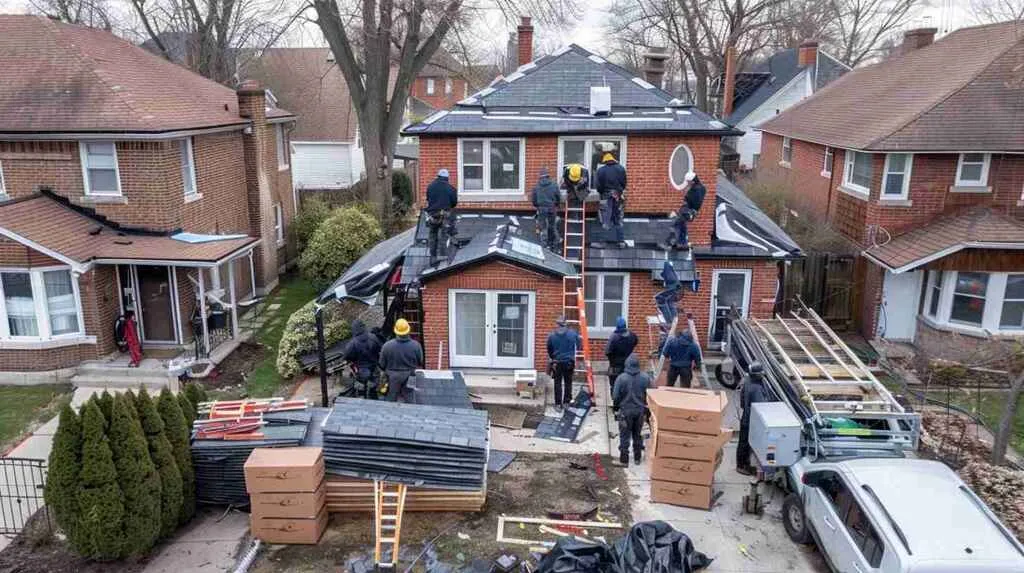
Roof Shingle Exposure Queens NY – What It Means and Why It Matters
Most shingle roofs in Queens don’t fail from “old age” or hurricanes-they fail early because the shingle exposure was wrong from day one. Shingle exposure is the distance from the bottom edge of one shingle to the bottom edge of the one above it that you can see, and manufacturers give us an exact number for a reason. The rest of this article shows you how to spot exposure problems on your own roof and what they’re costing you in years and money.
What Roof Shingle Exposure Actually Is on a Queens Home
Shingle exposure is the visible part of each shingle-the gap between the bottom of one shingle and the bottom of the shingle above it. Manufacturers specify this down to the eighth of an inch because it controls how much roof is actually doing the work of shedding water and resisting wind. When that number’s off, even by a quarter-inch repeated up the slope, most Queens roofs die 5-7 years early because the tabs curl faster, the nails end up in the wrong spot, and water finds its way under laps it was never supposed to reach.
One August afternoon around 5:30, the sun was bouncing off a white siding house in Bayside so hard I felt like I was on a grill, and I noticed the shingles on the south slope looked “stretched.” The homeowner swore the roof was only eight years old. I laid my tape measure across a few rows and found exposures almost a half-inch too big all the way up-whoever installed it had tried to “save time” by using the shadow line instead of their tape. That extra exposure had the tabs curling early and the top edges cracking; I showed the owner the difference between manufacturer spec and what was up there, and you could see the moment they realized their “young” roof was basically middle-aged. Think of each shingle course like stops on the 7 train-if the spacing between stops is off, the whole line gets delayed. Let me be blunt: there’s no such thing as “close enough” with exposure, and any roofer who doesn’t use a tape on exposure is gambling with your money.
| Shingle Type | Typical Exposure Spec | If Exposure Is Too Big | If Exposure Is Too Small |
|---|---|---|---|
| Standard architectural (Queens typical) | 5 5/8″ | Tabs curl early, cracks at top edge, faster granule loss. | Wavy lines visible from street, wasted material, water can back up at joints. |
| High-wind architectural | 5 1/2″ | Blow-offs in storms, nails too close to weather, leaks at nail line. | Roof looks bumpy, poor water flow toward gutters. |
| 3-tab shingle (older Queens roofs) | 5″ | Very prone to wind damage, uplift along bottom edge. | Shorter visual life, shingles crowd ridge area sooner. |
| Designer shingle | 6″ | Pattern looks stretched, water can jump laps in heavy rain. | Pattern misaligns with valleys, more debris catches on roof surface. |
| Myth | Fact |
|---|---|
| “As long as the lines look straight from the street, the exposure is fine.” | Straight lines can still hide exposure that’s off by 1/4″-1/2″, which can void warranties and shorten roof life. |
| “Exposure just affects how the roof looks, not how long it lasts.” | Exposure controls how much shingle is actually doing the work; wrong exposure directly cuts lifespan and storm resistance. |
| “My roofer said he can follow the shingle’s shadow line instead of measuring.” | Shadow lines are only a visual guide; they’re not a precise measurement and vary by brand and batch. |
| “All shingles use the same exposure number.” | Different brands and types have different required exposures, often differing by 1/8″-1/2″. |
| “Manufacturer exposure is just a suggestion; real roofers go by experience.” | Manufacturer exposure is engineered and tested; ignoring it shifts all the risk and cost onto the homeowner. |
How Wrong Exposure Shows Up on Queens Roofs
One windy November morning in Howard Beach, I got called to an emergency leak over a retired firefighter’s kitchen. The storm had ripped off only the top part of some shingles, which told me right away to check exposure before anything else. When I measured, the courses near the ridge were tight-perfect-but the bottom six rows above the gutter had exposures that kept getting bigger with each course, like a staircase. Water had been sneaking in through the nail line on those bottom rows for years, and the storm gusts just finished the job; that was the day I started carrying a Sharpie and writing the correct exposure right on the starter strip for my guys. Wind off Jamaica Bay hits neighborhoods like Howard Beach and Rockaway harder than anywhere else in Queens, and when exposure is off near the eaves and gutters, those lower courses take the worst beating from weather and fail first.
From the sidewalk or your driveway, the three main signs are stretched courses (where the shingles look taller than they should and you can almost see the nails), tight courses (where everything looks bunched up and wavy), and drifting lines (where the horizontal rows start to veer off course as they climb the roof). Each one sends water to the wrong places-over kitchen ceilings, into dormers, behind flashing-and what starts as a visual quirk ends up as a leak you can’t ignore.
Visible Signs Your Shingle Exposure Is Wrong
-
✓
Lines that look wavy or uneven from the street, especially in the middle of the roof slope. -
✓
Shingle tabs that look stretched or taller than normal, particularly on sunny south-facing slopes. -
⚠
Visible nail heads or shiny spots along the bottom edges of shingles (means exposure is too big). -
⚠
Shingles curling or cracking much earlier than the rated lifespan, especially along the top exposed edge. -
✓
Staircase pattern near gutters where lower rows appear progressively taller as you move up from the eaves. -
⚠
Missing or blown-off shingle tabs after moderate wind, particularly along the bottom three rows.
Relying Only on Interior Leaks as a Warning Sign
By the time you see a brown stain on your ceiling in Queens, shingle exposure and nail-line leaks may have been wasting your roof’s life for years, especially above kitchens, bathrooms, and around dormers. Don’t wait for visible water damage before having exposure checked-what you can’t see from inside is costing you thousands in lost roof life.
When to Call About Roof Shingle Exposure Issues in Queens
Call Right Away
- You see shingle tabs torn off or missing after a storm, especially near the eaves.
- There are visible “stair steps” where lower rows look taller than upper rows.
- You notice water stains on ceilings below roof edges or dormers.
- Shingles near the ridge are cracking while the rest of the roof looks new.
- You can see nails or shiny spots along exposed lines.
Can Wait a Few Weeks
- Lines look a little wavy but there are no leaks or missing shingles.
- The roof is 8-12 years old and you’ve never had a pro measure exposure.
- You’re planning to sell in the next 1-2 years and want a lifespan check.
- A home inspector mentioned “questionable installation” but no immediate leak.
- You just bought in Queens and don’t know who installed the roof.
Why Mixed or Sloppy Exposure Costs You Years of Roof Life
One weird, foggy early morning in Flushing-could barely see the top of the house-I inspected a roof where the owners complained about “wavy lines” they could see from the street. Walking that roof felt like walking on a washboard, and when I pulled a shingle, I found the installer had mixed two different brands with slightly different exposure requirements. Every few courses, the pattern drifted just enough to telegraph a bump you could see from the sidewalk. Explaining to that couple that the roof wasn’t about to collapse, but that the mixed exposures would shorten its life and hurt resale value, turned into a whole lesson in why “close enough” is not a thing with shingle exposure. Here’s an insider tip nobody shares upfront: before you sign a contract, ask your roofer, “What exact exposure number are you using for my shingles?” and pay attention to whether they give you a precise answer or a vague shrug.
Think of each course of shingles like rows of seats at Citi Field-if one row is pushed too far forward or back, the whole section stops working the way it was designed. Water needs to flow downhill in a controlled path, and wind needs to hit sealed edges, not exposed nail lines. In Queens, with all the turrets, dormers, and odd little valleys between additions and bump-outs, sloppy exposure sends water to the wrong “seats” and causes premature failure in spots that should’ve been the strongest parts of your roof.
Even a 1/4″ mistake in exposure repeated up the roof can steal 5-7 years off the roof’s life. That’s not a guess-it’s what I see every week on Queens roofs that looked fine when they were new.
| Approach | Pros | Cons |
|---|---|---|
| Measured, Manufacturer-Spec Exposure | Full rated lifespan, better storm performance, warranty more likely to hold, roof looks even from the street. | Takes a little more time and discipline; requires trained crews who actually use a tape measure. |
| Eyeballed or Mixed Exposure | Slightly faster install time on the day of the job, less measuring for the crew. | Higher chance of blow-offs, curling, leaks at nail line, wavy appearance, and 5-7 years lost off roof life; warranty risk. |
Near Gutters and Eaves
Overexposed shingles near gutters let wind get under tabs and drive rain back under laps, especially in neighborhoods like Howard Beach and Rockaway where wind off the water is stronger and more constant.
Around Dormers and Skylights
Crooked or tight exposure around dormers in places like Elmhurst and Jackson Heights can send water sideways into flashing joints, turning a small exposure mistake into a leak that ruins your upstairs bedroom ceiling.
Valleys and Small Valleys Between Add-Ons
On complex roofs with small valleys between extensions, bad exposure concentrates water where shingles are weakest and flashing has to work overtime, leading to early valley failures that spread to the main roof.
Ridge and Upper Courses
If exposure shrinks toward the ridge, the roof looks bunched up and can trap debris and snow, which is rough on older Queens homes with low slopes that don’t shed water and ice as quickly.
How I Check Shingle Exposure on a Queens Roof (Step by Step)
On a typical small Cape in Queens Village, the first thing I do is drop a tape measure across three shingle courses and ignore whatever the roof “looks” like. I’m checking the actual distance, not the appearance, and I write down the number before I even think about what might be wrong. If the manufacturer spec says 5 5/8″ and I’m seeing 6″ or 5 3/8″, that tells me the whole story-someone guessed instead of measured, and now the homeowner’s paying for it with a roof that’s aging faster than it should.
You don’t need to climb up there yourself-that’s my job. What you need to know is that a proper inspection includes measurements at the eaves, in the middle of the slope, and near the ridge, because exposure can drift as a crew works their way up. At Shingle Masters, we check all three zones, photograph what we find, and give you a written report with the exact numbers so you can see where your roof stands and what needs fixing.
Professional Shingle Exposure Check by Shingle Masters
We confirm the manufacturer and model before touching a tape measure, because different shingles have different specs.
We drop a tape across three to five courses in each zone and write down the exact measurements, not estimates.
If the spec is 5 5/8″ and we’re finding 6″ or 5 3/8″, we know there’s a problem that’s costing you roof life.
We document curling, nail exposure, wavy lines, and any early wear that ties directly to the wrong exposure.
You get exact numbers, photos, and a clear plan for fixing the exposure issues before they turn into leaks or full roof failure.
Quick Shingle Exposure Check from the Sidewalk
Before you call, here’s what you can safely look for from the ground:
- Stand across the street and look for wavy horizontal lines running up the roof slope.
- Check if shingle tabs near the gutters look taller or shorter than tabs near the ridge.
- Look for visible nail heads or shiny spots along the bottom edges of shingles (use binoculars if you have them).
- Note any missing or curled shingle tabs, especially in the bottom three or four rows.
- See if the pattern looks stretched or bunched compared to your neighbors’ roofs.
- Check whether all the horizontal rows are parallel or if some drift off course as they climb toward the peak.
Why Queens Homeowners Trust Shingle Masters for Exposure Issues
| Credential | What It Means for You |
|---|---|
| Licensed & insured in New York City | Your roof work meets local codes and safety standards. |
| 19+ years on Queens roofs | Real-world experience with Queens weather and housing stock. |
| Specialized in complex shingle layouts and exposure | Better performance on turrets, dormers, valleys, and additions. |
| Same-week exposure inspections available | You’re not waiting months while small problems get worse. |
| Detailed written findings with photos and measurements | You can see exactly where exposure is wrong and what it costs you. |
Correct shingle exposure is the difference between a roof that quits early and one that does its full job in Queens weather-wind, rain, snow, and everything the city throws at it. If you’ve noticed wavy lines, early curling, or you just want to know whether your roof was installed right, call Shingle Masters for a tape-measure-backed exposure inspection and a straightforward plan to correct any issues before they cost you thousands in early replacement or leak repairs.