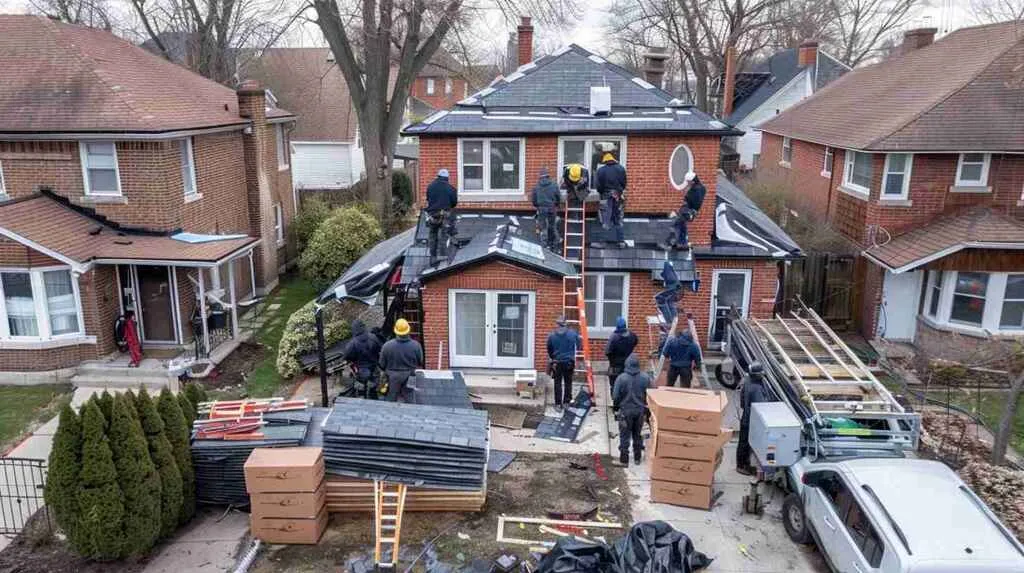
Pipe Flashing for Shingle Roof Queens NY – Get the Seal Right | Free Quotes
Quiet truth that most homeowners don’t discover until their bathroom ceiling is bubbling: that “fan leak” or “light fixture problem” isn’t a fan or light at all-it’s the little metal-and-rubber pipe flashing on your shingle roof that’s letting water slip through. I’ve been fixing roofs across Queens for 18 years, and I’ll tell you that 80-90% of the mystery leaks near bathrooms and kitchens trace back to those small flashings around plumbing vents, not the actual fixture people blame first.
Why That “Fixture Leak” Is Really a Pipe Flashing Problem
Stand on a two-story in Maspeth after a nor’easter, and you’ll see exactly why pipe flashing matters more than most people think. Water doesn’t just fall straight down-it follows the path of least resistance like electricity through a circuit, riding along shingle courses, running under tabs, and traveling sometimes twenty feet before it drips through your ceiling. One August afternoon in Woodside, it was so hot the shingles felt like soft rubber under my knees. A homeowner swore his skylight was leaking, but after I pulled up two courses of shingles I found a cracked rubber pipe boot hidden under a sloppy bead of black mastic from a job someone did in the 90s. Every time the morning sun hit that side, the crack opened, water slipped in, then tracked twenty feet down to show up by the skylight-took us an hour to fix the flashing and another half hour just to convince him the pipe, not the skylight, was the villain. Think of pipe flashing like the rubber gasket on a pressure cooker lid: when it’s good, steam stays locked in; when it splits or shrinks, all that pressure finds the weak spot. Your pipe is a conduit where leaks love to travel once they break through that seal.
Here’s my honest opinion: if your roofer can’t explain how water moves around a vent pipe like current through a circuit, you shouldn’t let them touch your shingles. The flashing around each pipe-whether it’s for a bathroom fan, kitchen exhaust, or plumbing stack-acts like a gasket that has to stay flexible through summer heat and winter freezes. When that rubber collar cracks or the metal base shifts, water sneaks in and follows framing, shingle edges, and nail lines until it finds an opening into your house. I’ve seen stains show up in bedrooms when the actual leak was above the kitchen, all because nobody understood how water travels once it gets under those shingles.
The fan isn’t the problem. The light fixture isn’t either. It’s that gasket on the roof that failed, plain and simple.
| Myth | Fact |
|---|---|
| If water stains are by the fan, the fan housing is leaking. | Most stains by bathroom fans come from failed pipe flashing boots above, not the fan itself. |
| Skylights are always to blame when stains show up nearby. | Water can run along shingle courses and framing, then appear 10-20 feet away from the bad pipe flashing. |
| A little roofing tar around the pipe fixes leaks for good. | Tar is a temporary band-aid that cracks and shrinks; proper flashing and shingle layout are the real fix. |
| If the leak only shows during heavy storms, it must be a major roof failure. | Many storm-only leaks are from small gaps or nail holes at pipe flashings that only open under wind-driven rain. |
On two-story homes in Jackson Heights, Bayside, and Astoria, wind-driven rain exposes every weakness in those flashings. A tiny crack you’d never see from the sidewalk becomes a highway for water when a nor’easter hits, and that water doesn’t care about your bathroom fixture-it’s already inside the roof system, running downhill until gravity and framing give it a path to your ceiling.
How I Diagnose Pipe Flashing Leaks on Queens Shingle Roofs
I’ll never forget a freezing January morning in Bayside with a light snow blowing sideways and a very anxious landlord calling every ten minutes. Tenants on the top floor had water dripping from their bathroom fan, and everyone thought the fan itself was shot. I climbed up, brushed off the snow, and found the pipe flashing collar had shrunk and split like an old rubber band-cold contraction had opened a hairline gap all the way around the vent. Once I showed them photos and replaced it with a metal base and silicone boot, the “fan leak” disappeared for good. Standing on a roof after a storm shows you exactly how water rides the shingles around plumbing vents, bath fans, and kitchen stacks across Queens neighborhoods. What looks perfectly fine from the street usually reveals tiny gaps, wrong nail placement, and UV-cracked rubber once you’re up there with a flashlight and a careful eye.
On my tool belt, the first thing I reach for on a pipe flashing job in Queens isn’t the hammer-it’s my camera, because I want you to see exactly what I’m seeing up there. I walk through a leak diagnosis the same way an electrician troubleshoots a circuit: first, locate which pipe sits directly above your ceiling stain; then check that boot, the nails around it, how the shingles were cut, and where the seal points have aged or failed. Water follows a predictable path once it breaks through, so I trace it backward from the drip to the source. Here’s an insider tip most roofers won’t mention: I always take roof photos for the homeowner before starting any work, because what looks minor from below usually shows clear evidence of gaps, rust streaks, and improper installation once you zoom in-think of it like opening a breaker panel to show exactly where the current is jumping and causing the problem.
Luis’s Step-by-Step Pipe Flashing Leak Check on a Queens Shingle Roof
- Match interior stain location to attic/roof layout – Ask yourself: “What pipe is directly above this spot?” Map it out before climbing.
- On the roof, start uphill from the pipe – Follow the shingle courses down like tracing a circuit, looking for lifted tabs or disturbed shingles.
- Inspect the pipe boot or flashing collar for damage – Check for cracks, splitting, dry rot, UV damage, or pulled-away edges where the seal has broken.
- Check nail placement carefully – No nails should be exposed or high on the uphill flange; look for rust streaks or nail heads in line with the leak path.
- Look under the shingles around the pipe – Find improper cuts, missing underlayment, or tar-only “repairs” from past work that didn’t address the real issue.
- Document findings with photos and explain – Show the homeowner the exact path water is taking, from shingle to pipe to ceiling, so they understand what failed and why.
Quick Decision: Do You Have a Pipe Flashing Issue?
Start here: Do you see a stain or drip near a bathroom, kitchen, or laundry ceiling?
- ❌ No → Your issue may not be pipe flashing; schedule a general roof check if your shingles are 15+ years old.
- ✅ Yes → Next question: Is there any vent pipe or plumbing stack on the roof roughly above that area?
- ❌ No → Leak may be from a different roof detail (skylight, valley, wall flashing); still worth a pro inspection.
- ✅ Yes → Next: Does the leak show up mainly during rain or snow, not when plumbing is in heavy use?
- ✅ Yes → High chance it’s a roof flashing issue, not plumbing-have the pipe flashing inspected soon.
- ❌ No → You may have both a roof and plumbing issue; call a roofer first to rule out the flashing, then a plumber if needed.
Proper Pipe Flashing Repair vs. Patch Jobs
I still remember one older brick house off Northern Boulevard where a $40 pipe boot was the difference between “minor repair” and “replace the whole ceiling.” One Saturday right before Thanksgiving in Jackson Heights, I got called to fix what another guy did during a quick shingle overlay. He’d cut a big ugly hole around the plumbing vent, slapped the new flashing over old brittle shingles, and nailed right through the uphill side of the flange-then smeared it with tar. During a heavy wind-driven rain, water rode the shingle courses under that flange, hit those nail holes, and dripped into a third-floor kid’s bedroom. I ended up stripping a whole section back, rebuilding the shingle layout, and installing new pipe flashing the way it should’ve been done in the first place; the dad told me that was the first dry storm they’d had in three years. A goop-and-tar job might hold for one season, but Queens weather-freeze-thaw cycles, summer sun, sideways nor’easters-will expose bad work fast.
Here’s how a correct repair actually works: shingles get woven properly over and under the flashing, with nails hidden in the right zones where water can’t reach them. The metal base sits flat against the roof deck, and a flexible boot forms a tight gasket around the pipe-think of it like the seal on a pressure cooker lid that has to stay snug no matter how hot or cold it gets. Proper flashing is a system, not a blob of caulk. When it’s installed right, water hits the flashing and gets directed over it and down the shingle courses, never finding a gap to slip through.
Quick Patch (What You Don’t Want)
- Tar smeared over old, cracked boot
- Nails driven through visible uphill flange
- No shingle layout correction, just covering what’s there
- Looks fixed for a season, then cracks and leaks return in heavy weather
Proper Repair (What I Do)
- Remove damaged boot and any rotten shingles
- Re-nail in correct, hidden zones with corrosion-resistant nails
- Rebuild shingle pattern so water is directed over, not under, the flange
- Use a new flashing with a snug, flexible collar that stays sealed through heat and cold
| Scenario | What’s Involved | Typical Price Range (Queens, NY) |
|---|---|---|
| Single worn pipe boot, easy access | Replace boot, re-secure shingles around pipe, seal and test | $250-$400 |
| Multiple flashings (2-3 pipes) needing replacement | Replace all boots, adjust shingle layout as needed, roof inspection | $450-$750 |
| Improper previous work with tar and bad nailing | Strip back shingles, correct layout, install new flashings, re-shingle section | $650-$1,100 |
| Pipe flashing plus localized sheathing damage | Replace flashing, cut out and replace small deck section, re-shingle area | $900-$1,500 |
Note: These are typical ranges for Queens homes. Exact pricing depends on roof height, pitch, and overall condition.
When to Call for Pipe Flashing Help in Queens
When I first walk into a home and someone points to a ceiling stain over a bathroom, I ask one question: “Where’s the pipe above this on the roof?” That tells me if we’re dealing with an urgent leak that needs same-day attention or something we can schedule within the week. Active dripping during a rainstorm, especially near electrical fixtures or recessed lights, means water is already inside your walls and ceilings-that’s a call-now situation. But a small, stable stain that’s been there for months without growing? That’s still a problem, just not an emergency. Either way, ignoring it turns a simple gasket-style fix into a ceiling replacement job, and nobody wants that.
Call Shingle Masters ASAP (Within 24 Hours)
- Active dripping during rain around bathroom fan or light
- Ceiling bubble or sag forming under the leak
- Water near electrical fixtures or recessed lights
- Dark, spreading stain that got noticeably bigger during the last storm
Can Usually Schedule Within a Week
- Small, light-brown stain that hasn’t changed in size
- Occasional drip only in extreme nor’easters
- Older home where shingles are 15-20 years old and you want a check-up
- You’ve seen cracked or curling pipe boots from the ground but no interior damage yet
Before You Call: Things to Note About Your Suspected Pipe Flashing Leak
- ✅ Note which room the stain or drip is in (bathroom, kitchen, laundry, bedroom).
- ✅ Check if the leak only shows during rain/snow or also when plumbing is heavily used.
- ✅ Look outside and see if you can spot any vent pipes or plumbing stacks above that area.
- ✅ Take a quick photo of the ceiling stain or drip to share.
- ✅ Estimate how long the stain has been there and whether it’s growing.
- ✅ If safe, note the approximate age of your shingles or when the roof was last replaced or overlaid.
Keeping Your Pipe Flashing Tight for the Long Run
Truth is, pipe flashing is like the rubber gasket on a pressure cooker-nobody thinks about it until steam, or in this case water, starts escaping. Just like you’d check the breakers in your electrical panel or replace a worn gasket before the pot starts hissing, periodic inspections keep your shingles, flashings, and sealants working together as one circuit for water control. In Queens, with our freeze-thaw winters and broiling summer sun, those rubber boots and metal flanges age faster than people expect, and catching a crack early saves you from chasing a mystery leak through three rooms.
| Interval | Task | Why It Matters in Queens |
|---|---|---|
| Every 1-2 years | Visual roof inspection from ground and, if safe, from roof: look at pipe boots, shingles around vents, and sealants. | Freeze-thaw cycles and summer heat here age rubber and caulk faster than people expect. |
| After major nor’easters or windstorms | Check for lifted shingles, shifted flashings, and new staining inside. | Wind-driven rain finds any tiny gap around pipes and can start a new leak overnight. |
| At 10-15 years of roof age | Evaluate all pipe flashings for proactive replacement, even if they haven’t failed yet. | Boots and gaskets often age out before the shingles themselves. |
| Whenever you renovate a bathroom or kitchen | Confirm the roof venting and pipe flashing above that room are up to date. | Upgraded interior systems deserve watertight protection above them. |
Common Questions About Pipe Flashing for Shingle Roofs in Queens NY
Can I just caulk around my pipe flashing instead of replacing it?
Caulk is like putting tape on a leaking wire-it might hold for a few weeks, but it’s not a real fix. Queens weather will crack and shrink that caulk fast, and you’ll be right back where you started. A proper repair means a sound boot or flashing that’s integrated with your shingles, sealed at every transition point, and able to move a little with temperature swings without breaking. If the boot is already cracked or the metal base has rusted through, no amount of caulk will make it work like new.
How long should pipe flashing last on a shingle roof in Queens?
Generally 10-20 years depending on sun exposure and material quality. Rubber-only boots on sunny south-facing slopes tend to fail on the early end of that range because UV degrades them, while metal-base flashings with silicone or EPDM collars can go longer if they’re installed right. If your roof is approaching 15 years old and you’ve never replaced the pipe flashings, it’s worth having them inspected even if you don’t see leaks yet-proactive replacement is way cheaper than emergency ceiling repairs.
Is pipe flashing repair noisy or messy inside the house?
Most jobs are done entirely from the roof with little or no interior disruption unless the decking underneath is rotten. You’ll hear some walking around and a bit of hammering, but it’s nothing like a full roof replacement. If we do find deck damage, we’ll cut out and replace just that small section, patch the ceiling from below if needed, and keep the mess contained. The whole repair usually takes a few hours, not days.
Do I need a whole new roof if just the pipe flashing is leaking?
Not usually. Many Queens homes get years more life from their shingles after targeted flashing repairs, as long as the field shingles are still in fair condition-no major curling, cracking, or granule loss. I’ve seen 18-year-old roofs that only needed new pipe flashings and a valley touch-up to go another five years dry. A good roofer will give you an honest assessment: if your shingles are shot, we’ll tell you; if they’re solid and it’s just the flashings, we’ll fix those and save you the cost of a full replacement.
Why Queens Homeowners Call Shingle Masters for Pipe Flashing Work
- Licensed and insured in New York City – Full coverage for every job, no exceptions.
- 18+ years hands-on roofing experience across Queens neighborhoods – From Corona to Bayside, we know these roofs inside out.
- Fast response for active leaks – Often same or next day for Queens zip codes when you’ve got water coming in.
- Specialized in diagnosing tricky pipe and vent leaks other roofers miss – We find the real source, not just the obvious symptom.
Most pipe flashing problems on Queens shingle roofs don’t need a full replacement-just a focused, proper repair done by someone who understands how water actually travels once it breaks through that gasket. If you’ve got a mystery leak near a bathroom, kitchen, or any ceiling fixture, don’t wait for the stain to spread or the ceiling to sag. Call Shingle Masters for a photo-documented inspection and free quote; I’ll walk you through exactly how water is moving around those vents and what it’ll take to seal things up right for the long haul.