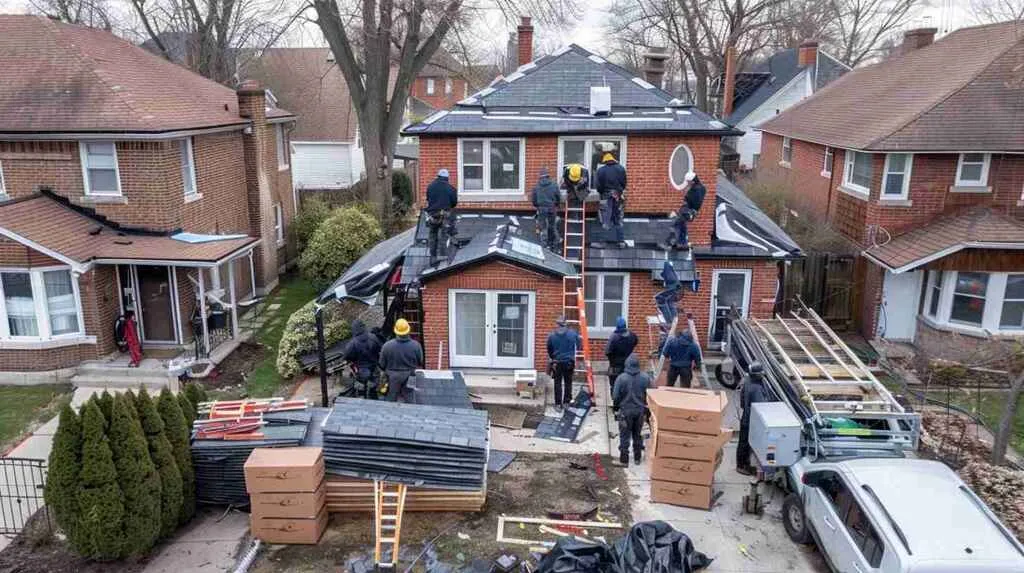
Layers of a Shingle Roof Queens NY – What’s Under Your Shingles
Layers. On a typical Queens shingle roof there are at least 5-7 distinct layers under what you see from the street, and missing just one of them is usually why leaks happen in the first place. I’m Carlos Mendez, and I’ve been on roofs across Queens for 19 years. Right now, I’m standing in your driveway with a pencil in one hand and a shingle in the other, and I’m going to walk you through every layer that sits between the sky and your living room-because once you understand what’s really up there, you’ll know exactly which questions to ask before any roofer touches your home.
The 5-7 Layers Under a Queens Shingle Roof, From Sky to Studs
Let me be blunt: if you don’t know what’s under your shingles, you have no idea how strong your roof really is. A typical shingle roof in Queens has between five and seven distinct layers, stacked from the visible surface down to the framing, and each one has a specific job in the system. Too many roof jobs around here are sold as “shingle packages” without anyone explaining the crucial hidden layers-the underlayments, the ice barriers, the deck structure-and that lack of detail is the difference between a roof that lasts five years and one that protects your home for 25. When I sit at a homeowner’s kitchen table and sketch their roof, I always start with the question, “Where do you think the first drop of rain actually lands in this system?” Most people point at the shingles, but the real answer involves understanding the line of water travel and the hidden structure that either stops that water or lets it creep into your ceiling.
Think of your roof like an architectural cross-section drawing. At the very top, you’ve got the visible shingles doing the heavy lifting against UV rays and bulk water. Under that, there’s a starter strip at the eaves and rakes that seals the first edge and fights wind uplift. Below that sits your underlayment-either synthetic or felt-acting as a secondary water-shedding layer. In critical zones like eaves and valleys, you’ll find ice and water shield, a self-sealing membrane that blocks wind-driven rain and ice dams. All of that rests on the roof deck-plywood, OSB, or old planks-which carries the load and holds every fastener. And finally, tucked just below the deck, you’ve got attic ventilation components and insulation that control temperature and moisture. The rest of this article is going to zoom the camera down one layer at a time, so you can picture exactly what’s happening above your head and why each piece matters in Queens weather.
| Roof Layer (Top to Bottom) | Main Job in the System |
|---|---|
| Shingles | UV and weather surface; sheds bulk water off the roof |
| Starter Strip Shingles | Seals shingle edges at eaves/rakes; first line against wind uplift |
| Ice & Water Shield (at eaves/valleys) | Self-sealing membrane that blocks wind-driven rain and ice dams |
| Synthetic or Felt Underlayment | Secondary water-shedding layer; protects deck from minor leaks |
| Roof Deck (Plywood/OSB/Planks) | Structural base that carries load and holds fasteners |
| Attic Ventilation Components | Lets hot, moist air escape; reduces ice dams and shingle wear |
| Insulation & Interior Ceiling | Keeps your living space comfortable and dry; shows first leak signs |
Peeling Back the Top: Shingles, Starter, and Underlayment
I still remember the first time I peeled back a “perfect” shingle roof in Forest Hills and found a mess of mismatched underlayments underneath. From the street, everything looked fine-newer shingles, clean lines, no obvious damage. But when we opened it up, there were random scraps of old tar paper, some synthetic patches, and even a stretch where the previous crew had run out of material and just overlapped nothing at all. That’s the thing about the top three layers of a Queens shingle roof: the visible shingle field, the starter strip at the edges, and the continuous underlayment beneath are supposed to work as one integrated system. In neighborhoods like Forest Hills and Jackson Heights, where row houses and semi-attached homes sit tight together, wind funnels down certain streets and puts serious pressure on those starter courses and edge shingles. If the underlayment isn’t continuous and the starter strip isn’t properly sealed, wind-driven rain from a nor’easter doesn’t just sit on top of your shingles-it gets pushed sideways under them, right through the gaps.
Under that visible shingle, you’ve got the starter strip running along every eave and rake, which is essentially a shingle turned backwards to seal the very first edge where wind loves to lift and pry. Below that sits your underlayment-either modern synthetic material or traditional felt-and this layer is absolutely not optional. It’s the secondary water-shedding barrier that catches any drips that sneak past a cracked shingle or a nail hole. Mixing random scraps of underlayment is a red flag, and I’ve seen roofs where someone pieced together old tar paper, cardboard (yes, cardboard), and bare spots, thinking the shingles would handle everything. That Flushing job from 2014 taught me just how fast a roof can fail when there’s no proper continuous layer underneath, but we’ll get to that in a second.
✓ Topside Layers Every Queens Shingle Roof Should Have
- ✓ Full field of manufacturer-rated shingles with proper exposure and nailing pattern
- ✓ Continuous starter strip shingles along every eave and rake edge, not just random cut pieces
- ✓ Uninterrupted underlayment-synthetic or felt-lapped and fastened correctly across the entire deck
- ✓ Ice & water shield membrane at eaves (at least 3 feet up from the edge), valleys, and around all penetrations
- ✗ Avoid pieced-together underlayment scraps or bare spots where someone “ran out” of material
- ✗ Never accept cardboard, plastic sheeting, or old tarpaper patches as substitutes for proper underlayment
!
Warning: Skipping or Patching Underlayment Under Shingles
In Queens’ mix of heavy rain, snow, and wind, pieced-together or missing underlayment is one of the main reasons roofs that “look fine from the street” leak inside. Back in 2014, after a nasty nor’easter, I got a call in Flushing from an older couple who’d just done a “quick reroof” the year before. The shingles looked fine from the street, but once I started lifting them, there was no proper underlayment-just patches of old, brittle tar paper and even a piece of cardboard someone had used to “smooth out” a dip in the sheathing. When I showed them the layers, or really the lack of layers, on a rainy Tuesday morning, the husband just shook his head and said, “So all this time, our roof was dressed up with no underwear?” That roof failed within one storm season because water had no secondary barrier-it went straight from the shingle seam to the wood deck and into their kitchen ceiling. Don’t let that be your roof.
The Critical Waterproofing Zone: Ice & Water Shield and Eaves
On a cold January morning in Queens, the very first thing I look at isn’t the shingles-it’s the wood deck underneath them, specifically at the eaves. That’s because in Queens, the edge of the roof where it meets the gutters is where many leaks actually start, thanks to ice dams and backed-up water that has nowhere to go. Ice and water shield is a self-sealing membrane-think of it like a thick, sticky Band-Aid for your roof-that should run along the eaves (at least three feet up from the edge), through every valley, and around penetrations like vents and chimneys. This membrane does something regular underlayment can’t: it seals around every nail that punches through it, creating a watertight barrier even when water is sitting still or creeping sideways. One August afternoon in Jackson Heights, it was 96 degrees and the shingles were almost too hot to touch. The homeowner swore the leak was “from the shingles,” but when we peeled things back, we found someone had skipped the ice and water shield on the eaves and just overlapped felt paper. I still remember standing there, sweat dripping off my nose onto the exposed plywood, tracing with my pencil exactly where water traveled under the shingle layer, across the bare deck seam, and into their dining room ceiling. That’s the line of water travel, and without ice and water shield, you’re basically hoping gravity and luck keep everything dry.
Here’s an insider tip: you can’t always see ice and water shield once the roof is finished, but there are ways to tell if it’s likely there. If the contractor did a full tear-off and you can find photos or video of the job in progress, look for rolls of black or grey membrane at the eaves before the shingles went down. Ask to see the material on-site before installation, or request that the crew leave a small exposed strip in a hidden spot-like behind a gutter or under an overhang-so you can verify it’s actually there. Some roofers will even mark the edge of the ice and water zone with a chalk line so inspectors (or you) can see the coverage area. In Queens’ freeze-thaw cycles, felt overlapped alone is not enough-water backs up under the shingles when gutters clog or ice forms, and that’s when a self-sealing membrane earns its keep.
How Water Sneaks Past Shingles at the Eave When Ice & Water Shield Is Missing
When snow melts or rain can’t drain, water pools at the eave and starts creeping back up the roof slope, lifting the bottom edge of the shingles.
Regular felt or synthetic underlayment overlaps but doesn’t seal-water finds the nail holes and lapped seams, then drips onto the wood deck below.
Plywood or OSB sheets butt together, and water follows that seam line downslope until it reaches the top plate of your exterior wall-right where the roof meets the house frame.
Once it’s inside the wall, gravity takes over-you see a brown stain on your dining room ceiling, and by then the wood has been soaking for days or weeks. That’s exactly what happened on that Jackson Heights job.
| Myth | Fact |
|---|---|
| “Queens doesn’t get cold enough to need ice & water shield.” | Queens has repeated freeze-thaw cycles and nor’easters that create ice dams along gutters, making ice & water shield vital at eaves. |
| “If the underlayment is overlapped, I don’t need anything else at the eaves.” | Overlapped felt or synthetic underlayment sheds water but doesn’t self-seal around nails, so wind-driven rain and ice melt can still reach the wood deck. |
| “Ice & water shield is only for fancy roofs or big houses.” | Even small row houses benefit from ice & water shield because the eave line is short and concentrated-one bad leak can affect multiple rooms. |
| “You can just patch a strip here and there and it’s the same as a full run.” | Partial, random patches leave vulnerable seams; the membrane needs to be continuous in critical zones like eaves and valleys to do its job. |
Hidden Structure: Roof Deck, Fastening, and Attic Conditions
Here’s the hard truth about Queens weather: your roof doesn’t fail where you can see it; it fails in the hidden seams between layers. When you zoom the camera down past the underlayment, you land on the roof deck-the structural base that everything else depends on. I’ll never forget a Saturday sunrise job in Astoria where we were tearing off three layers of old shingles. Underneath, instead of a continuous deck, we discovered a Frankenstein mix of original plank boards, particle board, and one random sheet of OSB held with about six nails. Every time I stepped near that patch, the whole thing flexed like a trampoline. We had to stop, rebuild that section of the roof deck, and I used that moment to show the owner how every layer above-underlayment, starter strip, shingles-depends on the integrity and fastening of that hidden wood she’d never seen before. In architectural terms, that’s the load path: shingles transfer wind and snow loads to the deck, the deck carries them to the rafters, and the rafters bring everything down to the walls and foundation. If the deck is soft, patched, or poorly fastened, none of the waterproofing layers above can do their job properly-shingles wrinkle, nails back out, and leaks start in spots that make no sense from the outside.
Just below that deck, tucked in the attic space, you’ve got ventilation components and insulation that most people never think about but that directly affect how long your shingles last and whether you get ice dams in the winter. In older Queens homes-especially the pre-war row houses and semi-attached places in neighborhoods like Astoria and Woodside-I constantly find blocked soffit vents, bathroom exhaust fans dumping moist air straight into the attic, and zero baffles to keep airflow moving from the eaves to the ridge. When hot, humid air gets trapped in the attic, it heats the underside of the roof deck, melts snow unevenly, and creates those ice dams we talked about earlier. It also cooks your shingles from below, cutting their lifespan by years. These problems don’t show from the street, but they change how the entire roof system behaves-and honestly, most leak calls I get could’ve been prevented if someone had just checked the attic conditions during the last roof job.
| Proper Continuous Deck (Plywood/OSB, Correctly Fastened) | Patchwork Deck (Planks, Particle Board, Random Patches) |
|---|---|
| Provides a stable surface so shingles lay flat and seal properly | Creates soft spots and flexing areas where shingles can crack or wrinkle |
| Distributes wind and snow loads evenly across rafters/joists | Concentrates loads on weak points, risking sagging or structural damage |
| Holds nails securely, reducing shingle blow-offs in Queens wind | Lets nails back out or miss solid wood, causing loose shingles and leaks |
| Gives inspectors and roofers a reliable base for future repairs | Hides problems until a major storm exposes them with sudden leaks |
How Often Queens Homeowners Should Check Hidden Roof Components
Go into your attic on a sunny day and look for daylight coming through the deck, dark stains on the wood, or blocked soffit vents. Check that insulation isn’t covering the vents and that you can see airflow channels.
After heavy wind or a nor’easter, have someone (preferably a roofer) walk the roof and look for lifted shingles, exposed nails, or soft spots that might indicate deck movement or moisture damage below.
During any major roof work or around the 10-year mark, have a roofer pull up a few shingles in different areas to inspect the deck condition, fastening pattern, and confirm ventilation is still working as designed.
Don’t wait if you see a dip in your roofline, a bulge under the shingles, or water stains on your ceiling. These are signs the hidden structure is compromised and needs attention right now, not later.
How to Tell If Your Queens Roof Has All the Right Layers
$750 later, a homeowner in Rego Park told me he’d spent more on ceiling repairs over two years than he would’ve paid to get the roof layers right the first time. That’s the reality: repeated fixes for leaks caused by missing underlayment or skipped ice and water shield add up fast, and they don’t solve the root problem. While you can’t see every layer once your roof is finished, there are specific questions you can ask and simple checks you can do before calling a roofer. An honest contractor should be willing to show you photos or videos of each layer as it goes down-think of it like construction drawings coming to life, where you can see the ice and water shield at the eaves, the continuous underlayment across the deck, and the starter strip sealed at every edge. That transparency is what separates a roof that protects your home from one that just looks good from the curb.
✓ Simple Checks Before You Call Shingle Masters About Your Shingle Roof Layers
-
☑
Check if you have photos or video from the last roof job showing the deck, underlayment, and ice & water installation-these are gold for understanding what’s actually up there -
☑
Look at your attic on a sunny day for daylight poking through deck seams, dark water stains, or any signs of previous leaks that were patched but not fixed at the source -
☑
Ask your current or previous roofer what brand and type of underlayment was used-if they can’t answer or say “standard tar paper,” that’s a red flag about attention to detail -
☑
Walk the perimeter of your house and note where gutters consistently overflow or ice forms-those spots are clues about whether ice & water shield is doing its job at the eaves -
☑
Check permits and inspection records if you have them-NYC building permits for roof work often include photos or notes about materials, and inspectors look for proper underlayment -
☑
Look for soft or spongy spots when you walk your roof (safely, from a ladder if needed)-flexing areas mean the deck below may be rotted, patched, or poorly fastened -
☑
Gather a list of every place you’ve ever seen a leak or stain, even ones that “went away”-mapping those spots helps a roofer trace back to which layer failed and where
Common Questions Queens Homeowners Ask About Shingle Roof Layers
Can I add new shingles over old ones and skip the underlayment work?
Technically, code allows one layer over an existing roof in some cases, but it’s almost never a good idea in Queens. When you shingle over old layers, you can’t inspect or replace the underlayment, ice & water shield, or deck-so you’re basically covering up problems and hoping they don’t get worse. Plus, the extra weight stresses the structure, and when that roof finally does fail, you’ll pay to tear off and dispose of double the material. It’s cheaper and smarter to do a full tear-off, check every layer, and build it right once.
How do I know if my roof has ice & water shield if I can’t see it?
You can’t see it once the shingles are down, but you can ask for installation photos, check permit records, or have a roofer pull up a shingle at the eave during an inspection to confirm. If your roof was done recently and you never saw black or grey membrane rolls on-site, there’s a good chance it’s not there. During the estimate phase, ask the contractor to specify the brand and coverage area of ice & water shield in writing-if they say “we’ll use it where needed” without details, push for specifics or find someone who will commit to a plan.
What’s the difference between synthetic underlayment and old-fashioned felt paper?
Felt paper (tar paper) has been used for decades and it works, but it tears easily, absorbs moisture, and degrades faster in sun and heat. Synthetic underlayment is lighter, stronger, and won’t wrinkle or rip during installation-plus it handles UV exposure better if there’s a delay between underlayment and shingles. In Queens, where weather can change fast and jobs sometimes pause for a few days, synthetic underlayment gives you more protection during the install and a longer service life under the shingles. Either way, the key is that it’s installed continuously with proper overlaps, not patched together from scraps.
Does attic ventilation really matter if my shingles are new?
Absolutely. Even brand-new shingles will age faster if the attic is hot and humid, because that heat cooks them from below and breaks down the asphalt. Poor ventilation also causes ice dams in winter, which put stress on your ice & water shield and eaves, and it traps moisture that can rot your deck and rafters. I’ve seen roofs with premium shingles fail in 10 years because the attic had no airflow and the deck rotted out. Proper intake (soffit vents) and exhaust (ridge or gable vents) keep the whole system healthy-it’s not optional if you want your investment to last.
Why Queens Homeowners Trust Shingle Masters with Layered Shingle Systems
Fully licensed, insured, and bonded to work on residential roofs across Queens, with every job meeting or exceeding NYC building code for shingle roof systems.
Carlos and the Shingle Masters crew have been working in neighborhoods like Jackson Heights, Astoria, Forest Hills, and Flushing since 2005-we know the housing stock, the weather patterns, and the hidden problems that come with it.
We photograph and document the deck, underlayment, ice & water shield, and shingle installation so you have a complete record of what’s under your roof-transparency is part of the service.
Our workmanship warranty covers the full roof assembly-deck fastening, underlayment, waterproofing, and shingles-because we build roofs that work as one integrated system, not just a cosmetic surface.
Once you understand the layers-from the visible shingles down through the starter strip, underlayment, ice and water shield, deck, and attic components-it becomes much easier to have a straight conversation with a roofer and know whether you’re getting a real system or just a patch job. If you’re in Queens and want someone to inspect your roof layer by layer, explain exactly what’s there and what needs attention, or design a full shingle roof system that’ll protect your home for decades, give Shingle Masters a call. We’ll walk you through it the same way I’ve walked hundreds of homeowners through their roofs: with a pencil, a sketch, and a commitment to doing it right the first time.