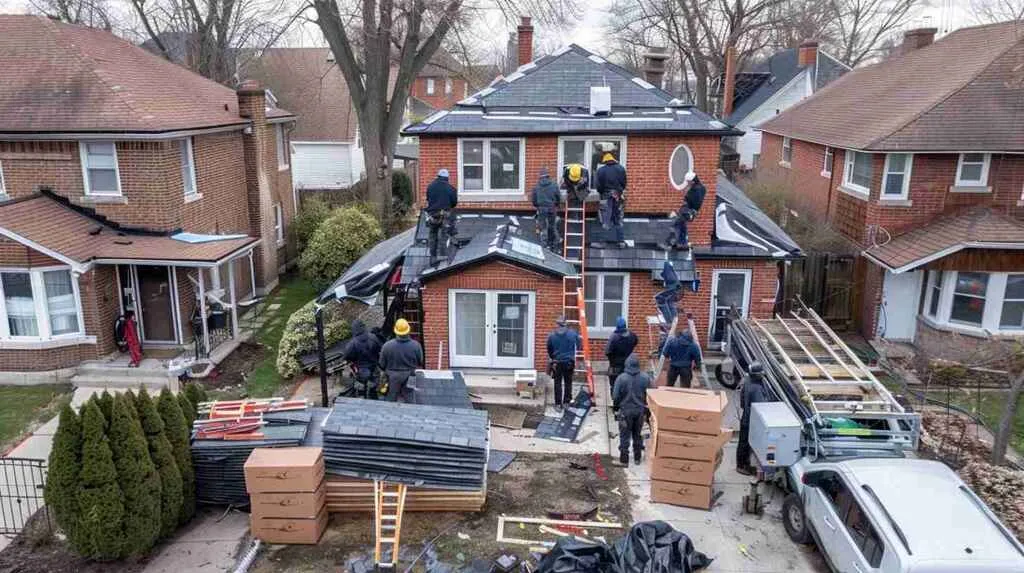
Hip Roof Shingle Pattern Queens NY – How Courses Line Up Right | Call Today
Blueprints lie. If the shingle courses on all four sides of a hip roof in Queens don’t meet within about a half-inch at those hip ridges, you’re basically buying leaks every time the wind kicks up off the bay. The very first move-before a single shingle gets nailed-is snapping a control line straight up each hip from eave to ridge, then snapping a parallel baseline along the eaves on all four sides, because that’s the only way you’ll know if your courses are running true or just following crooked fascia.
Why Hip Roof Shingle Patterns in Queens Live or Die on That First Line
Around here, wind doesn’t ask permission, and a hip roof that looks “close enough” from the sidewalk becomes a leak magnet the first nor’easter that hits. On a hip, you’ve got four slopes meeting at angled ridges, and if your shingle courses drift even three-quarters of an inch over twelve feet, the cut edges at those hips will either gap or overlap-both of which let water under the tabs when Queens wind lifts the corners. The tolerance isn’t huge: courses on opposite sides of a hip should meet within a half-inch, and the only way to hit that is snapping layout lines off a measured control point, not eyeballing it off fascia that’s probably sagging anyway.
On 43rd Avenue last summer, I proved to a skeptical engineer that the whole hip roof pattern lives or dies on your very first snapped line. He’d hired another crew who followed the edge of his house, and when the hips met, one side was riding a full inch higher than the other-looked like mismatched frosting layers on a crooked cake. Here’s my opinion, and you can frame it: if your roofer isn’t snapping lines on a hip, they’re decorating, not building. I pulled every shingle off the west slope, re-snapped a baseline parallel to the control line I’d run up the main hip, and when we re-laid those courses, they met at the ridge so clean you could slide a quarter along the joint and never feel a bump.
The very first layout move on a hip roof is snapping that control line straight up the center of your longest hip, then snapping your eave baseline on all four slopes using a consistent overhang measurement-usually 1″ to 1.5″-from the drip edge, not the fascia board. Why? Because in Queens housing stock, especially older neighborhoods like Astoria and Flushing, fascia boards twist, sag, and rarely run level. If you trust the wood instead of the chalk, your courses will “smile” or dip at the hips, and under wind uplift, those lifted corners become the first shingles to blow off. One quick insider move: before you snap anything, measure diagonally from corner to corner on your roof deck; if the two diagonals don’t match within an inch, your house is out of square, and you’ll need to adjust your baselines so the pattern stays true even when the framing doesn’t.
✅ What a Proper Hip Roof Shingle Layout MUST Do in Queens, NY
- ✅Courses on all four sides meet at hips within 1/2″, not 1″ or “close enough”
- ✅Chalk lines snapped off a measured control point up the hip, not the crooked fascia
- ✅Starter and first course aligned so cut edges don’t “smile” or dip at the hip ridges
- ✅Shingle exposure kept consistent (5″ or 5.5″) all the way to each hip, no drifting
- ✅Hips and ridges planned and pre-marked before the first shingle gets nailed down
⚠️ WARNING Common Hip Layout Mistake: Following the Fascia Instead of the Lines
Most Queens houses-especially in Astoria, Flushing, and older Jackson Heights blocks-are out of square by at least an inch, and fascia boards sag, twist, or bow over time. If a crew follows the edge of the house instead of snapped chalk lines, the shingle courses will curve or “smile” as they approach the hips, leaving cut edges that don’t sit tight against the hip ridge. Under Queens wind uplift-especially near Far Rockaway and the bay-those lifted corners expose nail lines and create entry points for water, making leaks and blow-offs far more likely than on a roof laid to true lines.
How I Actually Line Up Hip Courses So They Meet Clean at the Hips
One cold November evening in Flushing, right before it got dark, a neighbor came over complaining that the roof I’d done next door “didn’t line up with the street.” Turned out he was judging the hip shingle pattern from the sidewalk, and the house itself was out of square by almost two inches. I brought him up the ladder, showed him the chalk lines meeting perfectly at each hip, and then pulled a tape on his own crooked fascia board-it was bowed out three-quarters of an inch on the east side. He ended up hiring me to redo his roof because he realized it’s the hips and courses that have to be true, not the old carpentry. That’s the thing about Queens housing stock: walls settle, rafters twist, and you can’t trust the wood to tell you what’s level. The hips and chalk lines must run straight even when the framing doesn’t, because wind and water don’t care if your house is charming or historic-they only care if there’s a gap.
Here’s how I actually make those courses meet clean. Picture a pizza cut into four slices, but if the tip in the middle doesn’t meet, every slice looks wrong-that’s a hip roof if you skip the layout. You snap a control line up the main hip first, then snap parallel baselines along all four eaves at the same measured overhang. Starter courses get laid tight to those baselines, and then you snap horizontal layout lines up each slope at your exact shingle exposure-usually 5″ or 5.5″-tying every line back to that hip control. As you run field shingles toward the hip, you’re constantly checking that the cut edges hit your layout marks, not drifting to follow fascia or guessing by eye. By the time you reach the ridge, if you did it right, all four slopes meet within a half-inch, and the hip caps sit in a straight, tight line with zero telegraphing of mistakes below.
Step-by-Step: From Starter to Straight Hips
DIY vs Pro on Hip Roof Shingle Patterns in Queens
I’ll never forget a windy March morning in Jackson Heights where a DIY guy called me in to “just fix the ridge” on his hip roof. When I climbed up, he’d staggered his shingle pattern like a brick wall, not like a roof, so the cut lines on the hips looked like a set of stairs-each course landing a different distance from the ridge. Worse, he’d started each slope from a different measurement, so the courses met at the hips like mismatched teeth, some overlapping, some gapping by a full inch. I spent half the day re-laying starter and the first four courses on all four sides just so the hip caps could sit in a straight line without telegraphing all his mistakes. Here’s the insider tip nobody mentions in YouTube videos: always start every slope from the same measured control point-not “about here” or “close to the edge”-and pre-mark where your courses should meet at each hip before you lay a single shingle. If you don’t, you’re basically frosting a tiered cake one layer at a time without checking if the plates underneath are level, and by the time you reach the top, the whole thing leans.
Can You Tell If Your Hip Roof Pattern Is Already Wrong?
The first question I usually ask a homeowner with a wonky hip roof is, “Do you want it to look straight from the sidewalk or last 30 winters from the attic?” Most folks start by judging alignment from the street, but what actually matters is whether the shingle courses on opposite sides of each hip meet at the same height, whether cut edges sit tight against the hip ridge without gaps, and whether the exposure stays consistent all the way from eave to peak. Stand back about 20 feet and look up each hip line-if it looks like a set of stairs instead of a straight seam, or if the hip caps “snake” left and right instead of running dead-center, your layout is off. Check the corners where two hips meet at the ridge: if one side’s courses are riding higher or lower than the other by more than half an inch, wind will lift those shingles first, and water will follow.
Stop reading and go look up at your own hip lines right now. Seriously-walk outside, stand in your driveway, and trace each hip ridge with your eyes from bottom to top.
Blunt truth: the faster a crew races around a hip roof, the more the shingle courses drift, and drift on a hip is where leaks are born. If you see lifted shingle corners along the hips after a windy day, or if there’s a visible gap between the field shingle cut edge and the hip cap, that’s not “settling”-that’s bad layout showing itself. The good news is if you catch it early-before water starts staining your attic-it’s cheaper to fix the layout now than replace soaked plywood and insulation later. If any of these signs show up, it’s worth calling a pro who actually understands hip geometry, not just someone who knows how to nail shingles in rows.
Hip Roof Shingle Pattern FAQs for Queens Homeowners
Back when I still smelled like sugar instead of asphalt, I learned that aligning a hip roof shingle pattern is just like frosting a tiered cake-if the base is crooked, everything higher will lean. These are the questions I hear most from Queens homeowners in neighborhoods like Astoria, Flushing, and Far Rockaway, usually right after they’ve looked up at their hips and realized something doesn’t sit right. The answers matter because a hip roof that looks “fine” can still leak like a sieve if the courses drift at the ridges, and durability in Queens wind starts with layout, not just picking expensive shingles.
Common Questions About Hip Roof Shingle Patterns in Queens, NY
Q
How close do the shingle courses need to line up at the hip?
Q
Why don’t my shingles look level with the street even though a roofer said it’s right?
Q
Is it normal for hip caps to look slightly higher or lower on one side?
Q
Can you fix just the hips if the rest of the roof is already shingled?
Q
How does Queens wind change how you lay out a hip roof?
Why Queens Homeowners Call Shingle Masters for Hip Roofs
Licensed and insured in NYC for residential roofing work
22+ years hands-on shingle experience on Queens roofs
Specializes in tricky hip and chopped-up roofs that other crews avoid
Based in Queens, familiar with Astoria, Flushing, Far Rockaway, Jackson Heights
Typical response time for estimates within 24-48 hours
If your hip roof shingle pattern in Queens looks even a little “off”-courses that stair-step at the ridges, hip caps that snake instead of running straight, or cut edges that gap when you look up close-it’s cheaper to fix the layout now than pay for the leaks and blow-offs later. Wind and water don’t wait for you to “get around to it,” and every Queens nor’easter is a test your roof either passes or fails. Call Shingle Masters today for a straight, Queens-proof hip layout that lines up right, meets tight at every ridge, and lasts through decades of wind, rain, and whatever the bay throws at it.