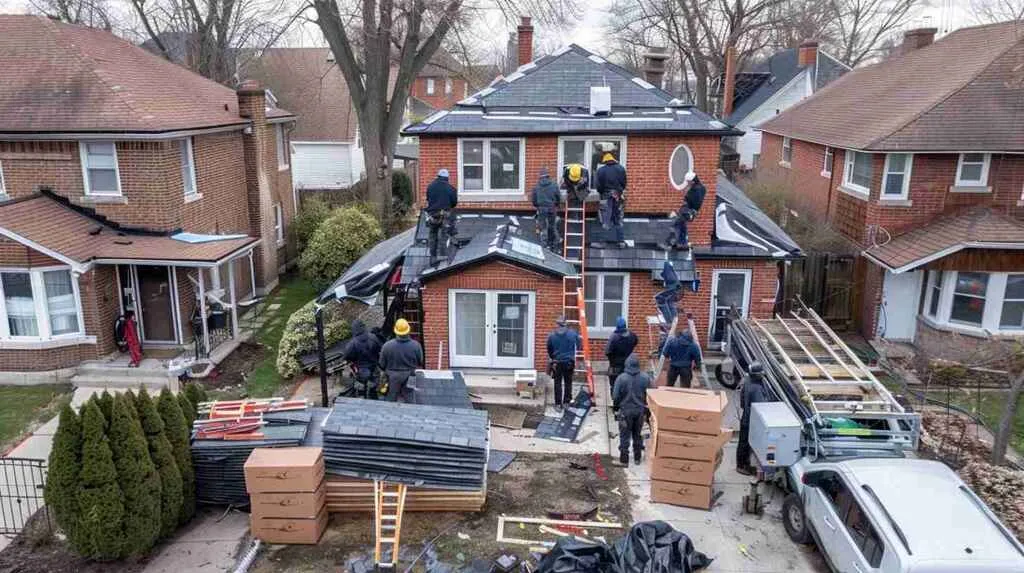
Flashing on a Shingle Roof Queens NY – What It Is and Why It Matters
Crossroads between perfectly dry attics and ruined ceilings, flashing on a shingle roof decides everything. On more than half the leak calls I run in Queens, I end up tracing water stains back to missing, bent, or just plain badly installed flashing-not shingles at all. This piece walks you through what flashing actually is, where it typically fails on Queens homes, how I hunt down those stubborn leaks, and what it’ll cost you to fix them right before your next big storm.
What Flashing on a Shingle Roof Actually Does on a Queens Home
On more than half the leak calls I run in Queens, homeowners swear their roof is “basically new,” and I have to break it to them that their shingles are fine-it’s the flashing that’s the problem. Flashing is the plumbing of your roof: thin pieces of metal or waterproof material tucked under shingles and sealed to walls, vents, and chimneys, channeling water down and away. Without it, water doesn’t just drip in-it wanders behind siding, soaks into plywood, and shows up ten feet away from where it actually got in. I never trust what anyone tells me about a roof until I’ve seen the flashing myself, and honestly, flashing details matter more for stopping leaks than the brand of shingle most of the time.
One February morning, about 7:15 a.m., I was on a steep little Cape in Maspeth with frost still on the shingles. The homeowner swore the roof was “basically new” but they had a brown ring on the dining room ceiling after every nor’easter. Took me twenty minutes of tracing and lifting shingles before I found the culprit: a ten-inch gap in the step flashing where a previous contractor had “saved time” and smeared caulk instead. The caulk shrank, water rode the siding, slipped behind the shingle roof flashing, and showed up ten feet away over the chandelier. That job made me stop trusting what anyone says about a roof until I see the flashing myself.
If you think of your roof like a subway map, then your flashing is the track switches-every joint, every vent, every transition is a decision point for water flow. A typical Queens shingle roof has five major flashing zones: where the roof meets a brick chimney, where it butts against siding on a side wall, in every valley where two roof planes meet, around every skylight or roof window, and at every plumbing vent or kitchen exhaust pipe poking through the surface. Miss even one of those spots or use the wrong technique, and water finds its way in.
✅ Key Places Flashing Protects on a Queens Shingle Roof
- ✅ Chimney base and sides – step and counterflashing guide water around the brick and into roof channels
- ✅ Where roof meets siding – continuous step flashing weaves under each shingle course and up the wall
- ✅ Roof valleys – open or closed metal flashing channels heavy runoff from two converging slopes
- ✅ Skylights and roof windows – layered pan flashing underneath prevents water from pooling at the curb
- ✅ Plumbing and kitchen vents – rubber boot or lead collar seals the penetration while allowing pipe movement
Common Flashing Problems I See in Queens (and the Red Flags Inside Your House)
When I walk up to your house, the first thing I’m scanning is every roof-wall transition, every chimney corner, and the base of every pipe sticking up. I’m looking for rust streaks, lifted shingle edges, missing sealant, or metal that’s been bent or pounded flat by a lazy job. In two-families in Elmhurst, I see a lot of shared chimneys with zero counterflashing cut into the masonry-just aluminum skirts nailed to the brick. In the semis out in Woodhaven, step flashing along the party wall gets skipped because the next-door neighbor “did their side last year,” so water gets sandwiched. And in attached homes in Astoria, those narrow side alleys make it hard for anyone to even inspect the flashing, so problems stack up for years until someone’s ceiling buckles.
One July afternoon in Woodhaven, it was 92 degrees and the shingles were practically melting under my knees. I was fixing a “mysterious leak” around a kitchen vent for an older couple who’d just redone their cabinets. Three guys before me had re-sealed the vent cap, but nobody bothered to look at the tiny L-shaped flashing piece tucked under the shingles. It had a nail driven right through the top edge-dead center in the water path. Every heavy rain, water ran along the flashing, hit the nail, and followed it straight into the plywood. I still use a photo of that nail in my estimates to show people how one bad fastener in flashing on a shingle roof can ruin a whole kitchen.
⚠️ Why Ignoring Small Flashing Leaks Is Risky
- Hidden rot in roof sheathing – plywood decking absorbs moisture for months before you see interior damage
- Mold colonies in wall cavities – water behind siding creates dark, humid conditions perfect for growth you can’t see
- Ruined insulation – wet fiberglass or cellulose loses R-value permanently and becomes a breeding ground for spores
- Increased repair scope after a Nor’easter – what could have been a $600 flashing fix becomes a $4,000 sheathing and ceiling reconstruction
How I Diagnose Flashing Leaks on a Shingle Roof in Queens
I still remember a little two-family in Elmhurst where the landlord had hired four different guys to “fix” the same leak, and every time it rained hard the second-floor tenant sent him another photo of the bedroom ceiling. When I got up there, I went through my whole leak autopsy process-inside first, then attic, then roof surface-and found that nobody had ever lifted a single shingle to see what the flashing actually looked like underneath. Here’s the thing: any roofer who suggests only smearing caulk over suspect areas without lifting shingles to inspect flashing is cutting corners and wasting your money. A real diagnosis means following the water from stain to source, step by step, even if it takes an hour.
Step-by-Step: My “Leak Autopsy” for Flashing Problems
I measure distance from walls, check paint texture, and look for patterns that repeat after specific weather
I trace wet spots on sheathing back toward their entry point, noting any rafter discoloration or mold
I scan chimneys, sidewalls, valleys, and vents for rust, gaps, lifted edges, or obvious damage
I check for proper overlap, fastener placement, and whether metal is corroded or torn
I isolate sections and run water to confirm the entry path-this step often surprises homeowners
I show you exactly what I found, explain why it’s leaking, and lay out your choices from patch to full replacement
When to Call About Your Flashing Issue
🚨 Call Right Away (Within 24 Hours)
- • Active dripping during or right after rain
- • Ceiling sagging or bulging from trapped water
- • Widespread bubbling or peeling paint
- • Water stain near electrical fixtures or outlets
📅 Can Usually Wait a Few Days
- • Small stain that hasn’t grown in weeks
- • Minor musty smell only after heavy storms
- • One-off drip that stopped and hasn’t returned
- • Old water ring with no fresh moisture detected
Repair vs. Replace: What Flashing Work in Queens Typically Costs
Here’s the part nobody likes to hear, but everyone needs to: flashing work is surgical and labor-heavy, so even small areas can feel pricey. We’re talking about peeling back shingles without breaking them, custom-bending metal to fit your specific roof geometry, sealing everything in layers, then putting it all back together so you’d never know we were there. But here’s the flip side-spending $800 on proper flashing now saves you $3,500 on ceiling drywall, mold remediation, and insulation replacement six months down the line. I’ve watched too many Queens homeowners chase interior damage for years because they tried to save $400 on the roof.
A simple plumbing vent reflash is straightforward and relatively quick-cut out the old boot, prep the base, slide in a new one, reseal the shingles. But a full chimney reflash is a different animal. Late one windy October evening in Astoria, around 6:30 p.m., I got called out by a landlord who was sick of his third-floor tenant texting pictures of “mold mushrooms” on the bedroom wall. When I got up there, I saw what looked like a fancy new roof, but the chimney had this shiny, store-bought “universal” flashing kit just slapped over the shingles. No counterflashing cut into the brick, no step flashing climbing the side-just a metal skirt and a lot of hope. The wind had been driving rain sideways under that skirt for months. I ended up tearing all of that off in the dark with a headlamp and rebuilding proper step and counterflashing. That’s why chimney work costs what it does-it’s not just metal, it’s masonry cuts, custom angles, and making sure every shingle layer ties into the system. Don’t let anyone sell you a universal kit when your chimney needs real step and counterflashing.
Typical Flashing Repair Price Ranges in Queens, NY
Prices vary based on roof pitch, accessibility, extent of hidden damage, and whether matching shingles are available. These ranges reflect typical residential work in Queens neighborhoods as of 2024.
Patching Old Flashing vs. Fully Replacing It
Simple Checks Before You Call a Roofer About Flashing
Let me be blunt: I don’t want you on your steep Queens roof with binoculars trying to diagnose flashing yourself. But you can do a lot from the ground and from inside your house before you call anyone. Walk around your property and look up-do you see rust streaks running down from the chimney? Bent or missing metal at the base of any vents? Shingles that look lifted near the siding? Inside, get close to that water stain and ask yourself: does it show up every time it rains, or only during wind-driven nor’easters? Does the shape look like it’s following a rafter line? Those clues help me narrow down the leak path before I even climb the ladder.
Can you picture exactly where your stain is in relation to the nearest exterior wall, and does it only appear during certain kinds of storms?
✓ What to Note About a Suspected Flashing Leak Before Calling Shingle Masters
- ✓ Where the stain is in the room – measure distance from the nearest exterior wall or chimney
- ✓ Size and shape of the stain – round spots vs. streaks tell different stories about water flow
- ✓ Whether it grows during every rain or only wind-driven storms – this helps isolate flashing vs. shingle failure
- ✓ Any musty smell near the area – indicates ongoing moisture even when surface looks dry
- ✓ Photos of the ceiling/wall and the exterior roof area from the street – I can often spot the problem zone before I arrive
- ✓ Age of the current roof if known – helps me guess whether flashing was replaced with the shingles
- ✓ Any previous roof or flashing work done there – I want to know if this is a recurring spot or a new issue
Here’s what that really means: you’re helping me see your roof through your eyes before I even show up, which makes my leak autopsy faster and more accurate. Think of flashing as the plumbing of your roof-water is going to flow where the metal channels tell it to go. If you had to explain this whole flashing thing to your cousin at a barbecue, you’d probably say something like, “It’s the metal strips that keep water from sneaking in where the roof meets stuff like chimneys and walls.” And honestly, that’s the core of it. The rest is just making sure those metal strips are installed right, sealed tight, and inspected before they fail.
Common Questions About Flashing on a Shingle Roof in Queens
How do I know if my leak is from flashing or shingles?
If your leak shows up only during wind-driven rain, appears far from the wet spot on the roof, or happens near walls, chimneys, or vents, it’s almost always flashing. Shingle leaks tend to drip straight down and show up during any heavy rain, not just storms with sideways wind.
Can you just re-use my existing flashing with a new roof?
Sometimes, if the flashing is relatively new, in great shape, and was installed correctly in the first place. But most of the time, old flashing is corroded, bent from removal, or wasn’t right to begin with. I always recommend replacing at least the step flashing and any rusted valley metal when we’re already tearing off shingles-it’s pennies compared to a callback leak.
How long should proper flashing last on a shingle roof in Queens weather?
Galvanized steel flashing typically lasts 20-30 years if installed correctly and painted or coated. Aluminum lasts about the same but can corrode faster in coastal areas or where it contacts certain roofing cements. Copper and stainless last 50+ years but cost more upfront. The key is proper installation-bad flashing fails in five years no matter what it’s made of.
Do you offer photos or videos of the flashing issues you find so I can see them myself?
Absolutely. I take close-up photos of every problem area-lifted shingles, corroded metal, gaps, improper overlap-and I’ll walk you through them on my phone or email them before I write the estimate. You should never approve flashing work without seeing exactly what’s broken and why it’s leaking.
Why Queens Homeowners Trust Shingle Masters for Flashing Work
Full liability and workers’ comp coverage on every job
Experience with every housing type from Maspeth to Astoria
When weather allows, we prioritize active leaks
You see every flashing issue we find, with explanations
Familiar with two-families, semis, attached homes, and their common flashing patterns
Flashing on a shingle roof in Queens isn’t glamorous, but it’s the difference between a dry house and a mold-filled disaster. Most of the leaks I chase down come from bad flashing, not bad shingles, and fixing them right the first time saves you thousands in ceiling repairs and remediation costs. If you’re staring at a water stain right now and wondering where it’s coming from, call Shingle Masters-we’ll run a full leak autopsy, show you exactly what’s failing, and give you a repair plan that actually stops the water before your next big storm hits.