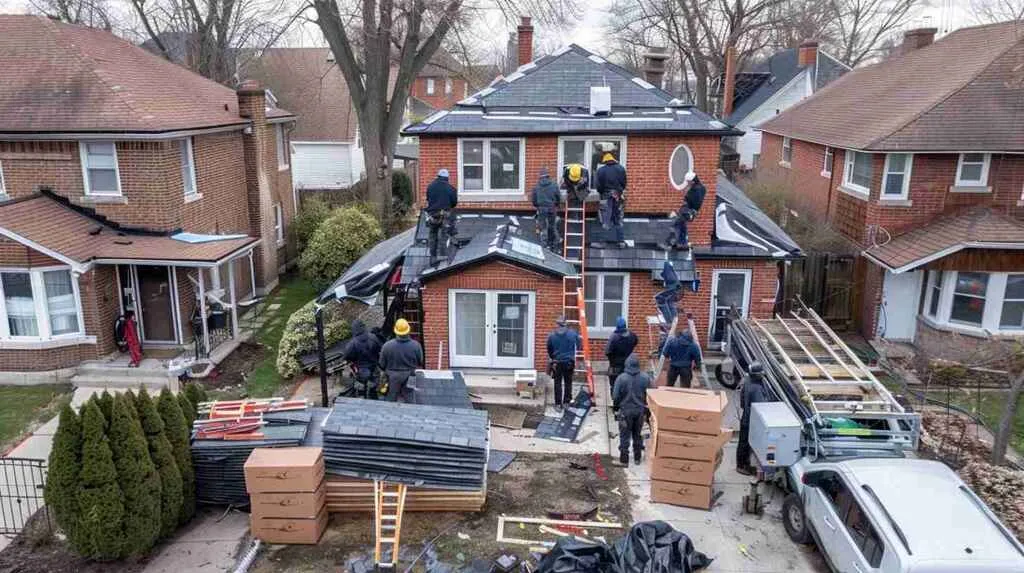
Best Underlayment for Shingle Roof Queens NYC – Felt vs Synthetic
Underneath every shingle roof in Queens sits a layer most homeowners never see but absolutely cannot afford to cheap out on: the underlayment. For most shingle roofs around here, a quality synthetic underlayment beats standard felt, hands down-it handles our wind-driven rain, freeze-thaw cycles, and those sudden August thunderstorms that turn the sky purple and dump two inches in forty minutes better than any felt I’ve torn off a leaky roof. Here’s the thing: I’m going to walk you through what actually happens to felt and synthetic when a nor’easter rolls in off Rockaway or when your contractor has to leave the underlayment exposed during a surprise rainstorm, hour by hour, so you can see for yourself why that choice matters more than the shingle color you’re agonizing over.
Here’s my honest take, no sales pitch: felt vs synthetic underlayment in Queens
Here’s my honest take, no sales pitch: if you’re putting a shingle roof on a house anywhere in Queens-whether it’s a narrow row house in Jackson Heights or a Cape on a ridge in Forest Hills-a quality synthetic underlayment is going to serve you better than standard #15 or #30 felt in almost every situation. I’m not saying this because I make more money on it (the installation labor is basically the same). I’m saying it because I’ve spent nineteen years on Queens roofs watching what happens when a storm hits at 3 a.m. and the wind is peeling back at the eaves and the rain is coming sideways off Jamaica Bay. Underlayment is your roof’s second line of defense-it’s what keeps water out when a shingle lifts, when an ice dam forms, when a branch punches through. Think of it like this: the storm starts, wind gusts to forty, a shingle edge flutters, rain drives under that gap, and the underlayment either sheds that water down to the gutter or it soaks it up like a sponge and lets it migrate sideways to your ceiling. That split-second performance difference is why I walk customers through this choice with a sketch on the back of a takeout menu every single time.
One February morning around 6:30 a.m., I was on a two-family in Flushing where the previous contractor had used basic felt underlayment and left it exposed for three days. We got a surprise freeze-thaw cycle-temps dropped to 18°F overnight, then jumped to 42°F by noon, and it drizzled. I watched that felt crinkle, bubble, and suck water like a paper towel under the shingles. The landlord couldn’t understand why the brand-new roof was leaking into the stairwell, and I had to peel the shingles back, layer by layer, to show him how the felt had literally turned into wet cardboard. That morning, standing on that icy roof with my hands numb and the landlord staring up from the driveway, I sketched out on my notebook what happens minute by minute: water hits felt, felt absorbs, freeze happens, felt expands and buckles, thaw happens, water migrates along the buckle, and suddenly you’ve got a leak three feet away from where the shingle lifted. Synthetic doesn’t do that-it stays flat, it sheds water, and it doesn’t care if the temp swings thirty degrees in six hours.
So here’s the if-this-then-that for most Queens homeowners: if your budget allows and you want long-term reliability through our unpredictable weather, go synthetic. If you’re doing a super tight budget reroof on a house you’re selling in six months, or if you’re patching a tiny shed that’s barely worth the materials, fine, felt will hold. But for a house you’re living in, where a leak means ruined ceilings and mold in the walls and a nightmare insurance claim, synthetic underlayment with proper ice-and-water shield at the eaves and valleys is the smart money. I’ve seen too many “cheap” felt jobs turn into expensive callback nightmares after one bad storm season to recommend it for a primary residence in Queens.
Quick verdict: Best underlayment for shingle roof in Queens, NY
Quality Synthetic Underlayment
- ✓ Best overall choice for Queens shingle roofs
- ✓ Handles wind-driven rain and sudden storms better
- ✓ Stays stable under short UV exposure during installs
- ✓ Less likely to wrinkle and telegraph bumps through shingles
- ✓ Better traction for crews on steep or coastal roofs
Standard #15/#30 Felt
- ✗ Older, cheaper option but more vulnerable to moisture
- ✗ Can crinkle, buckle, and absorb water if left exposed
- ✗ Less consistent performance in freeze-thaw cycles
- ✗ More prone to tearing in high winds off the water
- ✗ Only makes sense for very tight budgets or short-term roofs
On a cold, windy corner in Rockaway: what Queens weather actually does to underlayment
On a cold, windy corner in Rockaway, or in one of those narrow wind tunnels between row houses in Jackson Heights, or when a nor’easter barrels in over Bayside and the gusts hit fifty miles an hour-that’s when underlayment earns its keep or fails spectacularly. Here’s what actually happens, minute by minute: the storm front arrives, barometric pressure drops, wind speed jumps, and suddenly rain isn’t falling down-it’s flying sideways, hitting your roof at a forty-five-degree angle, working its way under shingle edges, probing every nail hole, every seam. If you’ve got synthetic underlayment, that water hits a slick, non-absorbent surface and gravity pulls it down toward the gutter. If you’ve got felt, especially older felt that’s been baking in the sun or sitting exposed during a long install, that water starts soaking in, the felt swells, and now you’ve got a layer that’s holding moisture right against your roof deck. Add in a freeze overnight, and that moisture expands, pushes fasteners, creates bumps, and when it thaws, you’ve got water migrating horizontally along the felt grain, searching for a nail hole or a gap in the deck to drip through into your attic.
I’ll never forget a Saturday in late August in Jackson Heights-it was 93 degrees, and we were reroofing a narrow row house with almost no yard. The neighbor’s kid was timing us with a stopwatch, and we had synthetic underlayment down instead of felt. A sudden thunderstorm rolled in off the East River-the sky went from clear to black in about twelve minutes, and we had to stop mid-job. That synthetic underlayment sat exposed in pounding rain and heavy wind for nearly two hours, and when we got back on the roof, it was still flat, tight, and bone-solid. If that had been felt, we’d have been cutting out soggy sections all afternoon. That job taught me something critical: in Queens, you can’t control when storms hit or how long a reroof takes, but you can control what’s sitting on that deck when the crew has to scramble down the ladder. Synthetic buys you time and forgiveness. Felt doesn’t.
| Queens Weather Scenario | What Happens to Felt | What Happens to Synthetic | Risk Level to Your Home |
|---|---|---|---|
| Sudden August thunderstorm (2+ inches in 45 min) | Absorbs water, buckles if left exposed, can telegraph wrinkles under shingles later | Sheds water cleanly, stays flat and tight, no performance loss | Medium with felt / Low with synthetic |
| Winter freeze-thaw cycle (18°F to 42°F in 12 hours) | Absorbed moisture freezes, expands, creates bumps and pushes fasteners, then leaks on thaw | No moisture absorption, no expansion, no issue-remains dimensionally stable | High with felt / Very Low with synthetic |
| Nor’easter with 50+ mph gusts off the water | Prone to tearing at fasteners, can lift or rip if not heavily fastened, absorbs driven rain | High tensile strength resists tearing, stays sealed at fasteners, sheds wind-driven rain | High with felt / Low with synthetic |
| Prolonged humid summer heat (90°F+ for weeks) | Degrades faster under UV if exposed, can dry out and become brittle over time | UV-stable for weeks of exposure, doesn’t dry out or crack, maintains flexibility | Medium with felt / Very Low with synthetic |
So when you ask me, “Luis, what is the best underlayment for shingle roof jobs around here?” I start with this:
A particular job in Bayside sticks with me because it went wrong before I even arrived. A DIY-minded homeowner had tried to save money by mixing underlayments-felt on the back slope, cheap off-brand synthetic on the front. I got called in after the first nor’easter when only the front bedrooms had ceiling stains. Crawling along that attic at lunchtime, with the rafters sweating from condensation, I traced the leak back to the seam where the two different underlayments met and overlapped wrong. That weird “half-and-half” choice made it crystal clear to me how underlayment performance isn’t just about material-it’s about consistency and details at every transition. Here’s what was happening during that storm: rain hit the ridge, ran down the back slope on felt (which was soaking it up), hit the transition seam where the felt overlapped the synthetic the wrong direction, and water that should’ve kept running down to the gutter instead wicked sideways along that seam, found a nail hole in the deck, and dripped into the bedroom. One material, installed correctly across the whole roof plane, would’ve shed that water cleanly. Mixing materials created a weak point that failed under the first real stress test.
Here’s an insider tip I sketch out for every homeowner on the back of my notebook: think about your underlayment like blocking a scene in a storm. Rain hits the ridge, gravity pulls it down, wind tries to push it sideways, and every overlap, every fastener, every transition is either helping water run off or giving it a place to pool and probe. Your rule-of-thumb checklist is simple: use one underlayment type across the whole plane, overlap every seam a minimum of six inches upslope (more in low-slope or high-wind areas), stagger your seams so they don’t line up vertically, and fasten according to the manufacturer’s spec-not more, not less. When I’m on a roof in a rainstorm, I watch water behavior minute by minute: it hits, it runs, it finds the path of least resistance. If your underlayment layer has consistent overlaps and no gaps, water runs down to the gutter. If you’ve got mixed materials, backwards overlaps, or under-fastened seams, water finds those mistakes and exploits them. That Bayside job taught me that you can buy the best synthetic in the world, but if you cheap out on half the roof or rush the details, you’re still going to get leaks.
✅ Non-negotiables for underlayment on Queens shingle roofs
- ✅ One continuous underlayment type across each roof plane-no mixing felt and synthetic on the same slope
- ✅ Minimum 6-inch overlaps at all horizontal seams, running upslope, with staggered vertical seams
- ✅ Ice-and-water shield at eaves (minimum 3 feet up from edge) and in all valleys-this is code in Queens and non-negotiable
- ✅ Proper fastener spacing per manufacturer spec-over-fastening synthetic can create leak points, under-fastening lets wind get under it
- ✅ Cap nails or staples rated for your slope and wind zone-cheap fasteners pull through synthetic in high wind
| Approach | Pros | Cons |
|---|---|---|
| Single, consistent synthetic underlayment system |
• Uniform water-shedding across entire roof • No weak transition points between materials • Predictable performance in all weather • Easier for crews to install correctly • Warranty typically covers whole system |
• Higher upfront material cost than felt • Requires following manufacturer’s exact install specs |
| Mixing felt and various synthetics |
• Can save a few dollars on less-critical slopes • Uses up leftover materials from other jobs |
• Creates transition seams that are vulnerable to leaks • Different expansion rates cause buckling • Hard to diagnose leaks when materials behave differently • Voids most manufacturer warranties • Crew has to switch install methods mid-job |
Think of your roof like a stage set-if the backdrop is flimsy, it doesn’t matter how nice the front looks.
If-this-then-that: choosing underlayment for your Queens home
Think of your roof like a stage set-if the backdrop is flimsy, it doesn’t matter how nice the front looks. I spent my first career as a stagehand in Astoria, and the same rule applies: what the audience sees (your shingles) only works if what’s hidden behind it (your underlayment) is solid, properly fastened, and built to handle stress. When I’m blocking a roof install, I treat it like choreographing a scene in a storm-if your house is within three miles of the water, if you’ve got an older home with shiplap or spaced decking instead of plywood, if your roof slope is under 6:12, or if you’re in an exposed spot where wind funnels between buildings, then you need a premium synthetic underlayment with ice-and-water shield at every vulnerable transition. That’s your stage direction, and you don’t improvise when the curtain goes up and a nor’easter is your opening night.
Which underlayment setup fits your Queens shingle roof?
START: Is your roof within 3 miles of the water or in a very open/windy spot?
YES → Premium synthetic (50+ year rated) + ice-and-water shield at eaves (minimum 3 feet), valleys, and around all penetrations. Wind rating matters here.
NO → Go to next question ↓
Is your roof slope 6:12 or steeper?
YES → Standard synthetic (30-year rated minimum) + ice-and-water shield at eaves and valleys. Good traction for crew, solid performance.
NO (4:12 to 6:12) → Go to next question ↓
Low slope (4:12 to 6:12): Are you planning to live in this house for 10+ years?
YES → Premium synthetic with enhanced slip resistance + ice-and-water shield covering more area (eaves, valleys, and any low-slope transitions). Low slopes pond water-don’t cheap out here.
NO (selling soon or temporary fix) → Standard synthetic is acceptable, but still use ice-and-water shield at code-required spots. Felt is risky even short-term on low slopes.
Extreme budget constraint: Can you afford synthetic at all?
YES → Go with standard synthetic and prioritize ice-and-water shield at critical areas. You’ll thank yourself after the first big storm.
NO (truly no budget) → Felt is your only option, but: (1) use heavier #30 felt, not #15; (2) double-layer it in valleys and at eaves; (3) get it shingled ASAP-don’t leave it exposed. And honestly, start saving now for a proper synthetic reroof in 5-7 years, because felt around here doesn’t age gracefully.
⚡ Queens underlayment quick facts
TYPICAL EXPOSURE WINDOW
2-7 days between underlayment install and shingle completion on most Queens roofs; weather delays can double this
COMMON SLOPES
4:12 to 8:12 on most row houses and Capes; steeper Victorians in some neighborhoods; flat or near-flat on older walk-ups
CODE & ICE BARRIER
NYC code requires ice-and-water shield at eaves and valleys; smart contractors add it at all chimneys, skylights, and dormer transitions too
CREW SAFETY & TRACTION
Quality synthetic provides better footing on steep or dew-wet roofs; felt gets slippery when damp, especially in morning fog off the water
Blunt truth: your shingles get all the credit, but your underlayment does all the quiet, dirty work.
$8,000 later, that “cheap” underlayment didn’t feel so cheap. I’ve seen that exact scenario play out a dozen times in Queens: homeowner saves $400 on felt instead of synthetic, then spends ten times that on interior repairs, mold remediation, and a callback reroof after one bad winter. Blunt truth: your shingles get all the credit, but your underlayment does all the quiet, dirty work-it’s the layer that stops water when a shingle cracks, when an ice dam builds at the gutter, when a squirrel chews a hole, when wind lifts an edge at 2 a.m. and rain pours through. For most Queens shingle roofs, a quality synthetic underlayment with proper ice-and-water shield at the eaves and valleys is the smartest money you’ll spend on the entire project. It’s not glamorous, nobody sees it from the street, but it’s what keeps your ceiling dry and your insulation mold-free when the weather goes sideways.
I know you’re wondering about cost and whether it’s really worth it, and I get the skepticism-everyone’s got a neighbor who says “my roofer used felt twenty years ago and it’s fine.” Maybe it is. But storms are hitting harder now, freeze-thaw cycles are more frequent, and insurance companies are getting pickier about what they’ll cover when you file a leak claim. So let me answer the questions I hear on every job, right up front, so you can make a smart call for your house.
▸ What’s the actual cost difference between felt and synthetic underlayment on a typical Queens roof?
On a typical 1,500-square-foot shingle roof in Queens, you’re looking at around $300-$500 more for quality synthetic underlayment versus standard #30 felt-labor is basically the same, it’s just the material cost. That breaks down to roughly $0.20-$0.35 per square foot extra. For a roof that’s going to last 20-30 years and protect a house worth $600K+, that’s about $15-$25 per year of extra cost. When I sketch this out for homeowners, I compare it to the cost of one ceiling repair after a leak: $2,000-$5,000 easy, plus the hassle. Synthetic pays for itself the first time it saves you from water damage.
▸ How long does synthetic underlayment actually last compared to felt?
Quality synthetic underlayment is typically warrantied for 30-50 years and will easily outlast your shingles if installed correctly. Felt, on the other hand, starts degrading from day one-it absorbs moisture, dries out under UV, becomes brittle, and loses strength. I’ve peeled back 15-year-old shingles to find felt that’s crumbled to dust in spots, while synthetic from the same era is still intact and flexible. Here’s the kicker: your shingles might last 25 years, but if the underlayment under them fails at year 12, you’re getting a new roof anyway. Synthetic ensures the underlayment isn’t the weak link.
▸ Can I hear or feel a difference inside the house between felt and synthetic underlayment?
Not really, no. Both are thin layers-you won’t notice noise or temperature differences from the underlayment itself. What you will notice, eventually, is whether your attic stays dry or develops stains and mold. That’s the real “feel” difference: peace of mind. I’ve crawled through hundreds of Queens attics, and the ones with synthetic underlayment almost always have cleaner rafters, no water marks, and no musty smell. The ones with old felt? Water stains, rust on the nails, sometimes black mold on the sheathing. That’s what you’re paying to avoid.
▸ Can I install underlayment myself, or do I really need a pro for this part?
If you’re handy, you can physically roll out underlayment and staple it down-it’s not rocket science. But here’s what I see go wrong on DIY jobs: overlaps in the wrong direction, inconsistent fastener spacing, no ice-and-water shield at critical spots, seams that line up vertically and create a zipper of potential leaks, and mixing different products without understanding how they interact. A good crew knows how to read the roof plane, adjust for wind exposure, detail around chimneys and vents, and most importantly, they know when to stop work if weather’s coming. On a Queens roof where one mistake can cost you thousands in water damage, I’d say hire a pro for the underlayment even if you’re doing the shingles yourself.
▸ What actually happens if underlayment gets left exposed in a Queens storm during the install?
With synthetic, usually nothing bad-it sheds the water, stays put, and you pick up where you left off. I’ve had synthetic sit exposed for a week through two rainstorms with zero issues. With felt, you’re rolling the dice. Light rain and it might be fine, though it’ll be damp and wrinkled. Heavy rain or wind and you’re looking at tears, buckles, absorbed water that takes days to dry, and a layer that’s now compromised before the shingles even go on. That Flushing job I mentioned earlier? Three days exposed in February freeze-thaw, and we had to tear off and replace half the felt before we could shingle. That’s time, material, and money down the drain because someone chose the cheaper option and got unlucky with the weather window. In Queens, weather is unpredictable-synthetic buys you insurance against bad timing.
Why Queens homeowners call Shingle Masters for underlayment and shingle work
✓ Licensed & Insured in NYC
Fully licensed, bonded, and insured for all roofing work in Queens and the five boroughs
✓ 19+ Years in Queens
Nearly two decades of experience on Queens roofs in every weather condition we get here
✓ Same-Week Inspections
We’ll get to your house fast, assess your roof and underlayment needs, and give you a straight-talk quote
✓ Storm-Tested Systems
We install underlayment and shingles the way Queens weather demands-premium materials, correct details, no shortcuts
I remember standing on a ridge in Forest Hills, watching the clouds roll in and thinking about all the roofs in this neighborhood that were about to get stress-tested by a storm nobody saw coming on the weather app. The ones with good underlayment would be fine. The ones with cheap felt and sloppy overlaps? Those homeowners would be calling roofers by Tuesday. Your roof is one of the biggest investments in your house, and the underlayment is the foundation of that investment. Don’t let someone talk you into saving a few hundred bucks now just to spend thousands later fixing the consequences. If you want a Queens roofer who actually plans underlayment around real storms-the kind that hit at 2 a.m. when the wind is howling and the rain is coming sideways-call Shingle Masters for an inspection and a straight-talk quote on the right synthetic and ice-barrier setup for your shingle roof. We’ll sketch it out on paper, walk you through what happens in a storm, and make sure you understand exactly what you’re getting before we roll the first foot of underlayment.