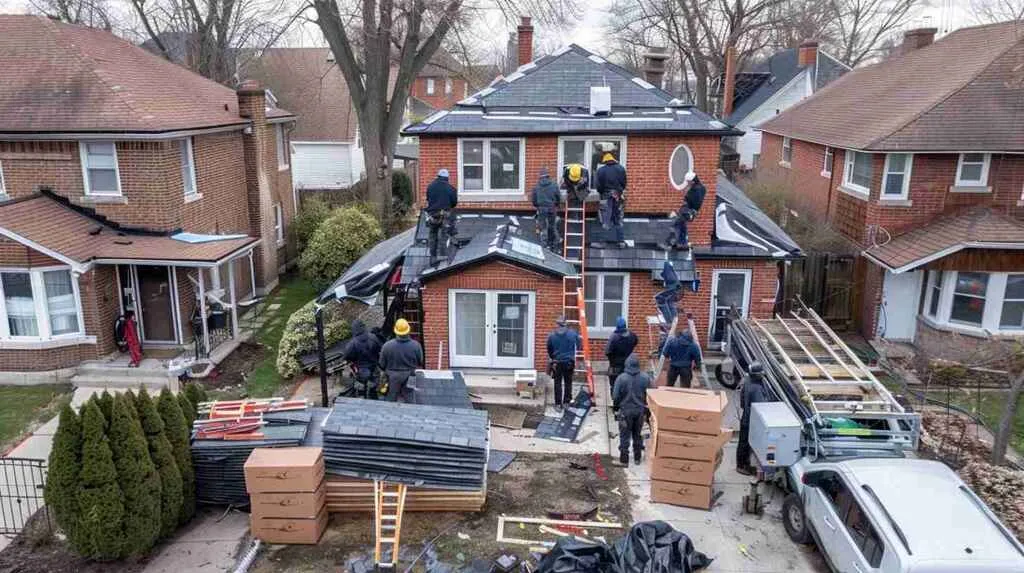
Commercial Slate Roofing Queens NY – Expert Install and Repair | Call Today
Blueprint: $18-$30 per square foot. That’s what a properly installed commercial slate roof in Queens runs, and if you’re wondering why someone would quote you $18 while another lands at $30, the answer sits mostly in structure, access, and the mistakes I refuse to repeat. The wide range isn’t arbitrary-it comes down to what’s hiding under your old slate, how water wants to move off your building, and whether we’re correcting past patches or starting clean.
Commercial Slate Roofing Costs in Queens: What’s Behind the $18-$30/sq ft Range
One January morning at 6:30 a.m., I was standing on a three-story office building off Queens Boulevard, watching my breath freeze while the property manager told me three previous contractors had “patched” his slate with caulk and asphalt. Every time the heat kicked on, meltwater ran behind the slates and straight into the conference room ceiling. I still remember how his face changed when I pried up one slate and showed him the rotten wood underneath-he went from “just fix the leak” to “okay, let’s do this right” in about ten seconds. That job is why I never agree to partial slate repairs over rotten decking; we stripped, replaced the deck, and re-slated the whole valley, and he hasn’t called me about a leak in eight winters. The honest truth is that I won’t quote cheap band-aid fixes over compromised decking, because it always costs more in the long run-both in money and in tenant complaints.
From a technical point of view, slate is the most honest roofing material you can put on a commercial building in Queens. Water wants to move downhill and find the smallest gap; stone wants to sit flat with full bearing across its back. When you respect those two behaviors, pricing becomes straightforward: the spread from $18 to $30 reflects how much correction we’re doing on parapets, valleys, and old patches, plus whether your decking can actually carry the load without reinforcement. Most Queens commercial structures have at least one surprise-parapet walls with crumbling mortar, valleys that were never designed for slate weight, or HVAC curbs patched with roofing tar. Honest pricing means I tell you about those behaviors upfront, not six weeks into the job when water’s already finding new routes inside.
Queens Commercial Slate Cost Scenarios
| Scenario | Building Type | Complexity & Access | Scope | Price Range/sq ft |
|---|---|---|---|---|
| Clean re-slate, sound deck | 2-story retail building, Astoria | Simple gable, crane access, no parapet issues | Full tear-off, synthetic underlayment, Vermont slate | $18-$22 |
| Deck replacement needed | 3-story office, Long Island City | Multiple valleys, 40% rotten plywood, limited staging | Strip, replace decking, new ice barrier, re-slate | $23-$27 |
| Parapet rebuild included | Mixed-use building, Jackson Heights | All four parapets need mortar/cap work, HVAC penetrations | Coordinated masonry repair, custom copper flashing, slate | $26-$30 |
| Partial section repair | Medical clinic, Flushing | Storm-damaged north slope only, deck is sound | Remove 600 sq ft, match existing Vermont slate, blend in | $19-$24 |
| Flat-to-slate transition | Warehouse addition, Woodside | Slate roof ties into existing TPO flat, multiple drains | Custom transition flashing, structural consult, slate install | $24-$29 |
Quick Facts: Shingle Masters Commercial Slate in Queens
Same-day or next-day scheduling for commercial properties in Queens
2-4 weeks for full commercial slate install, depending on size and weather
10-year guarantee on installation; slate material carries manufacturer lifetime rating
Astoria, Long Island City, Flushing, Jackson Heights, Woodside, Forest Hills
Why Slate Behaves Differently on Queens Commercial Buildings
There was this June afternoon, brutally hot, working on a slate roof over a small medical clinic in Jackson Heights, right after a hailstorm had torn through. The owner had been sold on “hail-proof” concrete tiles five years earlier instead of natural slate, and half of them were cracked like eggshells. I spent an hour on the roof with her, showing her the difference in density and how hail had bruised the underlayment, then we ran the numbers on upgrading to real commercial slate instead of doing another short-term band-aid. Today, when I drive by, I still look up at that dark-gray Vermont slate and remember her telling me, “I’m never buying a promise again, just stone.” Not all slate-looking roofs are equal, and Queens throws a particular set of challenges at commercial roofs: we get airport wind shear from LaGuardia, we get East River moisture that accelerates freeze-thaw cycles, and dense blocks trap heat in summer then dump it fast in winter. True commercial slate-dense, properly fastened over solid underlayment-handles those swings because the material itself doesn’t expand, crack, or delaminate the way concrete and composite imitations do. Water and temperature load the stone over time, but stone just sits there, unbothered.
When a customer in Flushing asks me, “Why is this bid higher than asphalt?” I always flip the question around: we’re not comparing materials, we’re comparing how weight, uplift, and thermal expansion work on your specific roof pitch and structure. Flat or low-slope commercial slate roofs in Queens deal with standing water longer, so underlayment and fastening patterns matter more. Steep-pitch roofs shed water fast but catch more wind uplift near parapets and edges. Cheaper systems-whether they’re concrete tiles marketed as slate or thin composite products-crack under hail or delaminate when freeze-thaw water gets between layers, because they weren’t designed with the same density or fastening redundancy. Here’s an insider tip: if you’re standing on the sidewalk and your “slate” roof looks perfectly uniform in color and thickness, with crisp, molded edges, you likely have concrete or composite tiles, not real stone. Real slate has slight variations in shade, natural cleft texture, and hand-cut or guillotined edges. If you can safely tap a piece with a hammer, stone rings dull and solid; concrete sounds hollow. That distinction matters in Flushing and older Queens commercial buildings, where original slate often got replaced with cheaper look-alikes in the ’80s and ’90s.
Real Slate vs. Concrete Imitation on Queens Commercial Roofs
| Natural Commercial Slate | Concrete/Composite Imitation Tiles |
|---|---|
| Impact Resistance: Absorbs hail energy; may chip but rarely cracks through; bruises underlayment less | Impact Resistance: Cracks or fractures under Queens hailstorms; transferred impact damages underlayment and deck |
| Weight per Square: 700-900 lbs; requires structural assessment but distributes load evenly | Weight per Square: 550-750 lbs; lighter but concentrates stress at fastening points |
| Lifespan: 75-100+ years in Queens climate with proper flashing maintenance | Lifespan: 20-40 years; delamination and color fade accelerate near waterfront areas |
| Typical Failure Mode: Fastener rust or flashing deterioration; slate itself outlasts the building | Typical Failure Mode: Surface spalling, cracking along ridges, delamination between concrete layers |
| Maintenance Needs: Inspect flashings every 18-24 months; replace slipped slates as needed | Maintenance Needs: Frequent crack patching; full replacement often needed before 30 years |
| Long-Term Cost per Year: $0.20-$0.35/sq ft annually over 80-year lifespan | Long-Term Cost per Year: $0.50-$0.90/sq ft annually over 25-year lifespan, plus replacement cycle |
Myth vs. Fact: Commercial Slate in Queens
| Myth | Fact |
|---|---|
| “Slate is always too heavy for Queens commercial buildings.” | Most pre-1960 commercial structures in Queens were built with slate in mind and already carry the load; post-1980 buildings may need a structural consult, but reinforcement is straightforward and one-time. |
| “You can’t repair slate in small sections-it’s all or nothing.” | We repair isolated storm damage or sections over sound decking all the time; the key is matching the slate source and blending fastening patterns so water still moves the way it wants. |
| “Slate roofs can’t handle Queens weather-too much freeze-thaw.” | Vermont and Pennsylvania slate were quarried specifically for Northeast freeze-thaw cycles; the stone is denser and less porous than concrete, so water doesn’t get trapped inside to crack it. |
| “‘Hail-proof’ marketing means my concrete tiles are as good as slate.” | No roofing material is truly hail-proof. Real slate absorbs impact better because of its density and cleft structure; concrete tiles marketed as hail-resistant still crack under 1.5-inch hail, as we saw across Jackson Heights in 2019. |
Details That Keep Commercial Slate Roofs in Queens from Leaking
Here’s a detail most people miss: the edges and penetrations on a slate roof are where almost every commercial leak starts. The job that still keeps me humble was a mixed-use building near Astoria Park where we were doing a slate replacement over an old restaurant. We started in late afternoon to avoid lunchtime rush below, and by 8 p.m. a surprise thunderstorm rolled in over the East River faster than the forecast said. I’d trusted a cheap temporary tarp while we staged materials, and the wind shredded it-water came in along one poorly protected chimney and stained the restaurant’s ceiling tiles. I spent my Sunday personally replacing every damaged tile and redesigning our temporary weather protection plan: double tarps, sandbags on edges, and never again underestimating Queens wind around open water. That experience taught me something critical: water is a stubborn character that will find any gap you leave, and wind near the waterfront will exploit every loose corner. Now I overbuild both temporary protection during construction and permanent flashings once the slate goes down, because respecting water and wind costs less than fighting them later.
If you’ve ever watched water run across your parking lot during a storm, you already understand how I think about a slate roof. Water wants the path of least resistance, and on a Queens commercial building that path usually tries to sneak in at parapet edges, around HVAC penetrations, through skylight curbs, along valleys where two slopes meet, and at transitions to flat roofs or gutters. Each of those spots needs custom flashing-not generic step flashing or a bead of caulk, but properly layered metal (copper or stainless) that guides water down and out without letting it backtrack under the slate. Parapet caps and counterflashing are the worst offenders; old mortar cracks, metal corrodes, and suddenly meltwater is running down the inside of your brick wall instead of off the roof edge. After any major storm or heavy snowmelt in Queens, I tell building owners to check those six areas first: look for water stains on interior walls near parapets, check ceiling tiles below HVAC curbs, and inspect valleys for debris dams that back water up under slates. Catching a problem there costs a few hundred dollars in re-flashing; ignoring it costs thousands once water rots the decking or damages tenant spaces.
✅ Key Leak-Prone Details We Reinforce on Queens Commercial Slate Roofs
- ✅ Parapet cap and counterflashing: Custom-formed metal cap, sealed into reglet, overlapping stepped counterflashing-no exposed fasteners
- ✅ Valley design: Open copper or stainless valley with minimum 12-inch width; slate edges cut to maintain water channel, not crimped or forced
- ✅ Chimney and cricket flashing: Full saddle cricket on upslope side if chimney is wider than 30 inches; step and counter flashing layered into mortar joints, not surface-mounted
- ✅ Transitions to flat roofing or gutters: Continuous cleat-fastened edge metal, termination bar, and sealant bead at top; transition flashing ties slate plane to membrane plane without gaps
- ✅ Skylight curbs: Pan flashing under slate, step flashing up curb sides, counterflashing into curb, and proper sealant at glass-to-metal joints
- ✅ Mechanical/HVAC curbs and pipes: Lead or neoprene pipe boots for small penetrations; custom curb flashing for rooftop units, with drainage directed away from equipment base
⚠️ Why Quick Patches Fail on Queens Commercial Slate
- Caulk and asphalt patches crack within 1-2 freeze-thaw cycles because they can’t flex with slate’s thermal movement; water then wicks under the patch and spreads across a wider area than the original leak.
- Single-layer tarps around parapets and chimneys shred in Queens wind, especially near open water or tall buildings; once a corner lifts, the entire tarp becomes a sail and water pours in faster than before.
- Generic aluminum step flashing corrodes quickly in Queens humidity and salt air; it also can’t conform to slate’s irregular back surface, leaving micro-gaps that collect ice and expand.
- Roofing cement over old flashing just hides the problem temporarily; the original metal underneath continues to corrode, and cement loses adhesion in summer heat, so leaks return worse than before.
Repair, Replacement, and What to Expect When You Call Shingle Masters
On a Tuesday last February, standing on a warehouse roof in Long Island City, I had to tell the owner something he didn’t want to hear: his “simple leak” around a skylight wasn’t simple at all, because the decking underneath had rotted out over a 10-foot radius and the old flashing was corroded through. He’d hoped for a $1,200 patch; the real fix was closer to $9,000 for decking, new curb flashing, and re-slating the area properly. I spent twenty minutes sketching the cross-section on a piece of cardboard so he could see exactly where water had been traveling for probably five years before it finally dripped on his inventory. That’s the conversation I have more often than I’d like in Queens: the difference between a spot repair that makes you feel better for six months, and a system-level fix that respects how water actually moves and how stone actually needs to sit. I don’t rush that explanation, because the decision has to be yours-but I will calmly walk you through the consequences of postponing the real repair, including what it’ll cost when the problem spreads to adjacent bays or damages the structure below.
When you call Shingle Masters about a commercial slate roof in Queens, here’s exactly what happens: we start with a phone consultation where I ask about your building age, roof pitch, recent leaks, and any past repairs you know about. Then I schedule an on-site inspection-usually same-day or next-day-where I get on the roof, check the attic or ceiling space below if accessible, and take photos of every vulnerable detail: edges, penetrations, valleys, and any visible damage. I explain what I’m seeing while we’re still on the roof, often sketching the problem areas on cardboard or the back of my clipboard so you can visualize the water path. Within 48 hours you get a written report with those photos, plus repair options versus full replacement options, each with transparent cost breakdowns. If we move forward, I lay out the scheduling plan and our on-site protection approach-how we’ll tarp, stage materials, coordinate with tenants, and keep weather out during the work. The final step is a walkthrough where I show you every flashing detail, explain the maintenance intervals, and hand you a folder with warranty documents and my cell number for any questions. The worst call I get is the “emergency” one at 9 p.m., after a landlord spent years postponing real slate repair with cheap patches-by then, water’s already inside the walls, tenants are complaining, and the repair bill has tripled.
How Shingle Masters Handles Your Commercial Slate Call
-
1
Phone Consultation: We discuss your building history, roof age, leak patterns, and any previous repairs; I take notes on pitch, access, and tenant coordination needs. -
2
On-Site Roof & Interior Inspection: I inspect the roof surface, parapets, flashings, and penetrations, then check the attic or ceiling space for hidden water damage and decking condition. -
3
Photo Documentation & On-Roof Explanation: I photograph every problem area and explain in real time how water is moving and where stone is failing; often includes a cardboard sketch so you see the layers. -
4
Written Options & Cost Breakdown: Within 48 hours, you receive a detailed report with photos, repair options versus replacement options, itemized costs, and honest recommendations based on structure and water behavior. -
5
Scheduling & Protection Plan: We coordinate start dates around your tenant schedules, plan material staging and crane access, and explain our double-tarp weather protection approach during the work. -
6
Final Walkthrough & Maintenance Guide: After completion, I walk you through every flashing detail and slate fastening pattern, hand you warranty documents, and provide a simple checklist of what to inspect every 18-24 months.
🚨 Call Us Immediately
- Active interior leaks with visible dripping or water pooling on floors
- Ceiling tiles sagging or stained brown across multiple rooms
- Storm damage with multiple slates missing or visibly broken
- Tarp failure during rain-water now entering faster than before
📅 Can Usually Be Scheduled
- Isolated drip marks that appear only during 50+ mph wind events
- Cosmetic slate delamination or discoloration without active leaks
- Small water stains that appear only after multi-day rainstorms
- Preventive inspection before winter or after tenant reports musty smell
Keeping a Queens Commercial Slate Roof Healthy for Decades
Every 18-24 months, I recommend a short inspection of your commercial slate roof-not an all-day event, just an hour where we check the six vulnerable details that start 90% of leaks. That’s Carlos’s maintenance philosophy: respect how water wants to move by catching problems before they become emergencies, rather than waiting for a 9 p.m. call when tenants are already complaining. This is exactly how the Queens Boulevard office building and the Jackson Heights medical clinic keep sailing through winters without calls-we caught a few slipped slates and resealed one parapet flashing on each, cost about $800 total per visit, and prevented the $15,000 decking disasters their neighbors are dealing with now.
Long-Term Care Schedule for Queens Commercial Slate
Inspect all parapet edges, penetrations, valleys, and transitions; look for slipped or broken slates; check flashing sealant and fastener condition; photograph any changes; clean gutters and scuppers of slate grit and debris.
Walk the roof within 48 hours to document any impact cracks or displaced slates; check that temporary tarps (if used) are still sealed; inspect chimney caps and HVAC curb flashings for uplift damage; file insurance claims promptly if needed.
Budget for flashing renewal: copper and stainless last 30-50 years, but fasteners and sealant joints need refresh; replace any slates showing delamination; verify that decking under high-traffic areas (near HVAC) is still sound; update building maintenance records with photos.
Coordinate with HVAC contractors before any unit replacement or ductwork; inspect slate around work zones immediately after; verify that temporary protection didn’t damage surrounding slates or flashings; document condition for warranty continuity.
Frequently Asked Questions: Commercial Slate Roofing in Queens
What’s the typical lifespan of a commercial slate roof in Queens?
Vermont and Pennsylvania slate routinely last 75-100+ years in Queens climate when properly installed and maintained. The slate itself often outlives the building; what needs periodic attention every 30-50 years is the flashing, underlayment around penetrations, and fasteners. We’ve repaired roofs in Forest Hills and Astoria that were originally installed in the 1920s and still have 80% of their original slate in good condition.
Can my existing Queens building structure support the weight of commercial slate?
Most pre-1960 commercial buildings in Queens were designed with slate or tile in mind, so the framing already handles 800+ lbs per square. Post-1980 buildings built for asphalt may need a structural engineer’s review, but reinforcement-if required-is usually straightforward: sistering rafters or adding purlins. We coordinate that assessment before quoting, so there are no surprises. In my experience, about 70% of Queens commercial structures can carry slate as-is.
How noisy is slate during a Queens hailstorm?
Slate is noticeably louder than asphalt during hail, but quieter than metal. You’ll hear the impacts as sharp taps rather than thuds. For commercial spaces like medical offices or quiet retail, we can add an extra layer of sound-dampening underlayment if noise is a concern, though most tenants say they only notice it during severe storms and actually appreciate knowing the roof is taking the hit instead of letting damage through.
How do you coordinate slate work around active tenants or clinic hours?
We schedule the noisiest work-tear-off and deck replacement-for evenings or weekends if your tenants need daytime quiet. Slate installation itself is relatively quiet (hand-nailing, no heavy equipment on the roof). We stage materials with a crane in a single lift to minimize disruption, and we always maintain at least temporary weather protection over active spaces so you never have to close for weather concerns. On the Jackson Heights clinic job, we worked 4 p.m.-midnight for two weeks and the doctors never had to cancel a single appointment.
Is partial slate replacement ever a smart long-term option?
Yes, but only if the existing decking and adjacent flashing are sound. If storm damage is isolated to one slope and the rest of the roof is performing well, we’ll replace just that section and blend the new slate to match. However, if your roof is 60+ years old with original flashings or the decking is soft in multiple areas, partial replacement just delays the inevitable and you end up paying twice-once for the patch and again for the full job three years later. I’ll always tell you honestly which situation you’re in.
From a technical point of view, slate is the most honest roofing material you can put on a commercial building in Queens. It doesn’t pretend to be something it’s not, it doesn’t promise miracles, and it doesn’t fail quietly. Water wants to move downhill, stone wants to sit with full bearing, and if you respect both of those behaviors with proper structure, correct flashing, and regular checks at the edges where leaks start, you’ll have a roof that outlasts your mortgage and maybe your building’s next owner. If you want a commercial slate roof in Queens that respects how water and stone actually behave-not how marketing says they should-Carlos and Shingle Masters can inspect your building, explain exactly what’s needed, and quote it clearly, without the surprises that come from ignoring physics. Call Shingle Masters today for a commercial slate inspection or repair plan, and let’s talk through what your roof is trying to tell you.