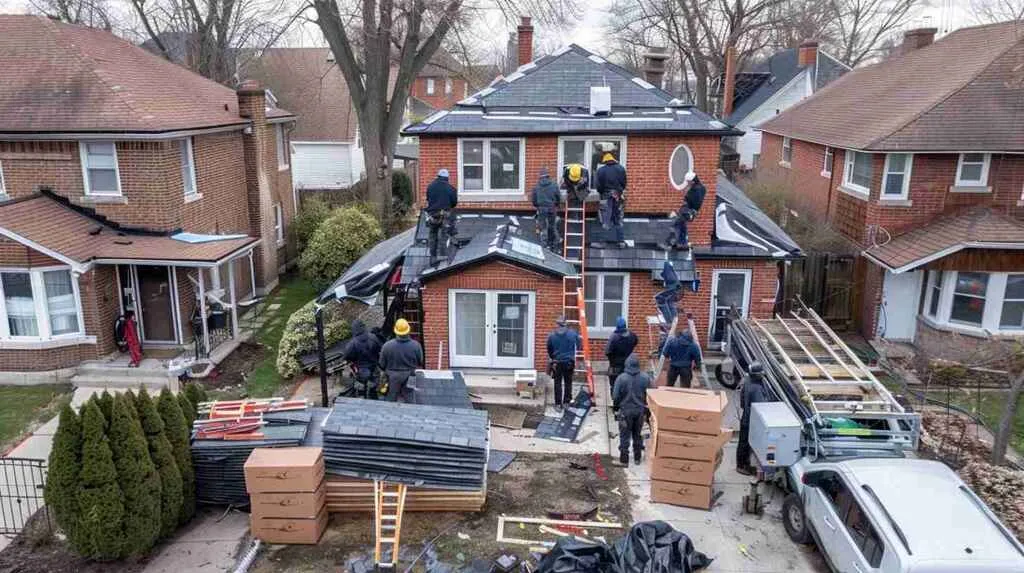
Commercial Asphalt Shingle Roofing Queens NY – Built to Last | Free Quotes
Blueprints don’t lie, and neither do I: a solid commercial asphalt shingle roof in Queens right now should run you somewhere between $5.50 and $9.00 per square foot, depending on how much tear-off you need, what the decking looks like underneath, and whether your building has weird transitions or heavy parapet work. When I see a bid that’s way below that range-like $3.50 or $4.00 a foot-I know exactly what’s happening: someone’s skipping the tear-off and inspections, rushing the underlayment, or using fasteners that won’t hold when we get hit with those winter winds off the bay.
Think of it this way: in aviation, we called it your “risk altitude”-how high you’re flying with how much margin for error. A cheap roof quote is like taking off without checking your fuel and hoping you don’t hit turbulence. Sure, you saved money on the ground, but you’re buying yourself a leaky emergency in about five to seven years. I’ve seen it play out too many times across this borough, and that’s exactly why I frame every commercial job like a full pre-flight check: we figure out your real risk, build a proper flight plan, and make sure you land safe.
What a Solid Commercial Asphalt Shingle Roof in Queens Should Really Cost
Let me put some real numbers in front of you. A proper commercial asphalt shingle roof in Queens-one that includes complete tear-off, deck inspection and repairs, new underlayment, code-compliant nailing, and clean flashing at every transition-is going to cost you in that $5.50 to $9.00 per square foot range I mentioned. The low end is for straightforward, low-slope buildings with good access and minimal parapet work; the high end is for taller buildings, complicated roof lines, and situations where we find rotten decking once we peel back the old layers. Anything drastically cheaper than that? Someone’s taking shortcuts that will show up as brown ceiling stains and panicked phone calls within half a decade. If you ask me straight, I’ll tell you: I’d rather lose a bid than watch a building owner pay twice-once for the cheap job, then again when it fails and they call me to fix it the right way. That’s not just my opinion; it’s what I’ve learned from 19 years of watching how Queens weather tests every single corner that was cut during installation.
I think about a deli owner I met one December morning in Astoria, right after sunrise. He’d been setting out buckets under a dining room leak for three years straight, convinced it was just “normal aging.” When we climbed up there, we found three full layers of old shingles stacked over decking that was so rotten I could punch through it with my hand. The original contractor had just nailed new shingles right over the old ones to save the client tear-off costs-classic risk altitude with zero margin. Halfway through our tear-off, a surprise storm rolled in off the East River, and we spent the next two hours tarping that building in 40 mph gusts, fighting to keep water out of his kitchen. That job taught me to insist on full deck inspections for every commercial asphalt shingle roof, even when an owner only “sees a small stain on the ceiling.” The real pricing-the honest pricing-has to include tearing everything down to the deck and checking what’s actually holding your building together, because that’s the difference between a roof that lasts 20 years and one that starts failing before you’ve even finished your loan payments.
Commercial Asphalt Shingle Roof Cost Ranges – Queens, NY
These are ballpark estimates for a 2,000 sq ft commercial roof in Queens. Actual prices depend on access, decking condition, and roof complexity. All scenarios assume full permits and code-compliant work.
| Scenario | Roof Size (sq ft) | Price per sq ft (Queens) | Estimated Total Range |
|---|---|---|---|
| Simple tear-off, good decking Single layer removal, minimal repairs |
2,000 | $5.50-$6.50 | $11,000-$13,000 |
| Multiple layers, moderate deck repair 2-3 layers, expect 15-20% decking replacement |
2,000 | $6.75-$7.75 | $13,500-$15,500 |
| Complex roof with transitions Parapets, penetrations, HVAC curbs, skylights |
2,000 | $7.50-$8.50 | $15,000-$17,000 |
| Heavy repair + architectural shingles Extensive rot, upgraded materials, complex flashing |
2,000 | $8.25-$9.00 | $16,500-$18,000 |
⚠️ If you’re quoted under $5.00/sq ft for a full commercial job in Queens, ask exactly what’s being skipped.
At 7:15 on a Winter Morning in Queens, the First Thing I Check on a Commercial Roof
At 7:15 on a winter morning in Queens, the first thing I look at on a commercial roof isn’t the shingles-it’s the edges. Eaves, rakes, and every transition point where two roof planes meet. That’s where our wind and freeze-thaw cycles do the most damage, and it’s where cheap installations fall apart first. You can have the heaviest architectural shingles money can buy, but if the starter course is missing or the drip edge wasn’t installed correctly, those shingles will lift and blow off the first time we get a real nor’easter. I’ve done enough jobs in Astoria, Long Island City, and down near the Rockaways to know that salt air and wind tunnels between buildings don’t forgive sloppy edge work. In neighborhoods like Jamaica and Corona, where buildings sit close together and wind gets funneled down narrow streets, the edges take a beating that would shock you if you could watch it in slow motion during a storm.
Back in July 2018, during a brutal heatwave, I re-roofed a small church near Jamaica Avenue that was losing shingles every time the wind picked up. The original contractor had nailed high and completely skipped the starter course on the eaves, so the whole system was weak from day one-it was like trying to hold a plane together with half the rivets missing. I still remember the pastor bringing us ice water while we re-aligned the shingle pattern and beefed up the nailing to meet high-wind specs. That experience is why I always walk commercial clients through fastening patterns like I’m teaching a class-because the part you never see is what keeps your business dry. Proper starter courses, ice-and-water shield underlayment at the eaves, and correct nail placement (four nails per shingle in the field, six at edges and high-wind zones) aren’t sexy details, but they’re what separate a roof that protects your revenue from one that turns into a tarp-and-bucket emergency at the worst possible time.
Key Edge & Fastening Details for Queens Commercial Asphalt Shingle Roofs
| Detail Area | Correct Method (What I Do) | Cheap Shortcut (Watch For) | What Happens in Queens Weather |
|---|---|---|---|
| Starter Course | Full starter strip with adhesive backing at every eave and rake edge | Skipping starter or using regular shingles upside-down | First course lifts in wind; water runs under shingles and into building |
| Nail Placement | 4 nails per shingle in field, 6 nails within 3 feet of edges and ridges | Nailing too high or using only 3 nails to save time | Shingles blow off in 40+ mph winds; warranty voided |
| Drip Edge | Metal drip edge under underlayment at eaves, over underlayment at rakes | No drip edge, or installed backwards | Fascia rots from wind-driven rain; ice dams form and back up under shingles |
| Underlayment at Transitions | Ice-and-water shield minimum 3 feet up from edges; overlap and seal all seams | Using felt paper everywhere or leaving gaps | Water penetrates at seams during freeze-thaw; leaks show up years later as hidden rot |
✅ High-Wind Fastening Must-Haves for Queens Commercial Shingle Roofs
Why Heavier Shingles Alone Won’t Save a Queens Commercial Roof
I still remember a restaurant in Elmhurst where the owner thought “heavier shingles” meant “indestructible roof.” He’d upgraded to premium architectural shingles but kept all the old flashing and never fixed the weird transition between the main building and the kitchen addition. Shingle weight without proper flashing, transitions, and underlayment is like adding passengers to a plane without checking the engines-you’re just increasing your risk altitude with no safe landing plan. One fall evening in Flushing, just as it was getting dark, I got a panicked call from a small day-care center: shingles had blown off in a nor’easter and water was coming in over the nap room. When I got up there with my headlamp, I realized the shingles themselves were fine; the problem was a badly designed transition from the main slope to a little “eyebrow” over the playroom. We rebuilt that section, corrected the flashing, and re-shingled with a heavier architectural shingle to handle our Queens wind tunnels. Now whenever I design a commercial asphalt shingle roof, I over-focus on those weird transitions, because that’s where real-world storms love to test you.
Pros & Cons: Heavier Architectural Shingles on Queens Commercial Properties
✅ Pros of Heavier Architectural Shingles
- Better wind resistance: Thicker, multi-layer construction and higher-quality adhesive strips help shingles stay put in Queens coastal winds
- Longer lifespan: Quality architectural shingles last 25-30 years in our climate vs. 15-20 for basic 3-tab
- Improved curb appeal: Dimensional look increases property value and tenant appeal for commercial buildings
- Stronger warranties: Premium lines often include better wind coverage (up to 130 mph) and longer material defect protection
⚠️ Cons / Limits You Still Need to Manage
- Weight isn’t magic: Heavy shingles on bad flashing or wrong nailing patterns will still fail-money wasted
- Higher material cost: Adds $1.00-$2.00 per sq ft; only worth it if installation details are correct
- No fix for design flaws: Upgraded shingles won’t solve poor drainage, bad transitions, or missing ventilation
- Warranty fine print: High-wind coverage often requires certified installation and specific fastening-most cheap crews don’t qualify
Warning: “Heavier Shingles” Isn’t a Magic Fix
Spending extra money on premium architectural shingles without redesigning your flashing, fixing transitions, and upgrading your underlayment is like buying expensive tires for a car with bad brakes. In Queens, where salt air, freeze-thaw cycles, and wind-driven rain test every weak point on your roof, heavier shingles will fail just as fast as cheap ones if the system around them is wrong. Don’t let a contractor sell you an upgrade and skip the real work-proper prep, correct fastening, and quality flashing matter more than shingle weight every single time.
Your Flight Plan: How a Commercial Asphalt Shingle Replacement Actually Works
When I sit down with a building owner, my first question is never “What color do you want?”-it’s “How long do you need this roof to perform before you even think about it again?” That question sets the whole flight plan: your budget, your risk tolerance, what kind of warranty makes sense, and most important, what it means for your business. If you’re running a restaurant and you can’t afford to close for weather emergencies, we need a roof that won’t give you any surprises for at least 20 years. If you’ve got retail tenants who’ll call you every time there’s a stain on their ceiling, we need to over-build at the transitions and flashings so you’re not fielding complaints. This isn’t about shingles; it’s about translating roofing decisions into direct business impact-fewer panicked calls, less downtime, predictable maintenance costs, and a building you can actually stop worrying about.
Here’s an insider tip that most contractors won’t bother with: timing and logistics in Queens can make or break your experience. If you’re a restaurant in Jackson Heights or a retail shop in Forest Hills, we’ll schedule tear-off and noisy work around your quietest hours-usually early morning before you open or late afternoon after lunch rush. Tight street access? We coordinate dumpster placement with the city and plan material deliveries so your customers aren’t fighting past a construction zone. For buildings with limited roof access, we’ll use cranes or hoists and get permits lined up weeks in advance so your job doesn’t stall halfway through. That’s what I mean by planning a “safe landing”-making sure the entire project happens with minimal disruption, so your business keeps running and your tenants don’t even notice we were there until they see a brand-new roof.
Step-by-Step: Commercial Asphalt Shingle Roof Replacement with Shingle Masters in Queens
Think of this as your complete flight plan-from pre-flight inspection to safe landing and final paperwork.
I walk your entire roof with a checklist, documenting every layer, checking deck condition from below, noting drainage issues, photographing transitions and flashing, and identifying any hidden problems before we ever price the job.
You get a line-by-line breakdown: tear-off costs, decking repairs, materials (brand and grade), labor, permits, dumpster, timeline, and payment schedule. No surprises, no “we’ll figure it out later.”
We pull NYC permits, coordinate dumpster and material deliveries, confirm access and staging areas, and lock in a start date that works around your business hours and weather windows.
We strip the roof down to bare decking, inspect every square foot, replace any rotten or damaged sheathing, and document everything with photos so you know exactly what we found and fixed.
Underlayment, drip edge, ice-and-water shield at all critical areas, starter courses at every edge, shingles with correct nailing patterns (six nails at edges), custom flashing at transitions, ridge vents if needed-everything by the book.
We walk the finished roof together, review all work, confirm cleanup is complete, pass city inspection, and hand you warranty paperwork for both materials and our labor. You get a maintenance checklist and my direct number for any future questions.
Why Queens Property Owners Trust Shingle Masters for Commercial Asphalt Shingle Roofs
NYC and NY State licensed, with full liability and workers compensation coverage for every crew member on your property
From aircraft maintenance at JFK to commercial roofing across Queens-precision, checklists, and no shortcuts
Most inspection requests scheduled within 48 hours; emergency leak service available for active water intrusion
Deep experience in Astoria, LIC, Flushing, Jamaica, Forest Hills, Corona, Elmhurst, and Rockaways-we know your weather and building codes
Every quote breaks down materials, labor, permits, and contingencies-no vague “roof replacement” line items or hidden fees
Before You Call for a Quote, Run These Pre-Flight Checks
A few simple checks before you pick up the phone will make your quote faster, more accurate, and way more useful. When you can tell me specifics instead of “I think the roof is old,” I can talk real numbers instead of guessing. If you’re a first-time commercial buyer, don’t worry-this isn’t a test, it’s just helping both of us skip the back-and-forth and get you a solid price on the first call.
✅ Before You Call Shingle Masters: Information to Gather About Your Queens Commercial Roof
Photos of the roof: Wide shots from street level, close-ups of any problem areas (stains, missing shingles, sagging), and pictures of any visible leaks inside the building
History of leaks: When they started, how often they happen, what triggers them (heavy rain, snow melt, wind), and where water shows up inside
Age of the current roof: Even a rough guess helps (10 years? 20? 30?). If you have paperwork from the last roofing job, that’s gold.
Access details: How do we get on the roof? Ladder access only, internal stairwell, adjacent building, crane needed? Tight street parking or loading zone available?
Business hours and tenant schedules: When can we work without disrupting operations? Are there noise restrictions or preferred times?
Prior patch jobs or repairs: Has anyone tried to fix this roof before? What did they do, and did it help or just delay the problem?
Any active leaks right now: If water is coming in today, tell me immediately-we can often get a tarp or temporary fix in place while we plan the full job
Frequently Asked Questions: Commercial Asphalt Shingle Roofing in Queens, NY
How long does a commercial asphalt shingle roof last in Queens?
With proper installation and regular maintenance, a quality commercial asphalt shingle roof in Queens should give you 20-25 years for basic 3-tab shingles and 25-30 years for architectural shingles. Our salt air, freeze-thaw cycles, and wind off the water do shorten lifespans compared to drier climates, so correct installation details-especially at edges and transitions-matter more here than almost anywhere else. If someone promises you 40 years, they’re overselling; if they say 10-15, they’re using cheap materials or bad methods.
How is pricing built for a commercial asphalt shingle roof-materials vs. labor?
On a typical Queens commercial job, materials (shingles, underlayment, flashing, fasteners, decking) run about 40-45% of the total cost, and labor (tear-off, installation, permits, cleanup, dumpster) is 55-60%. That ratio shifts if we find major deck rot (more materials) or if your building has complicated access or a lot of transitions (more labor hours). Anyone quoting you with materials at 60% or higher is either padding the materials markup or skimping on labor hours-which means rushed, sloppy work.
Do I need permits and inspections for a commercial roof in NYC?
Yes, absolutely. Any commercial roofing work in New York City requires a building permit from the Department of Buildings, and you’ll need a final inspection when the job is complete. The permit process usually takes 2-4 weeks, and it costs a few hundred dollars depending on the scope of work. Skipping permits is a huge risk-you can get fined, your insurance might not cover damage from unpermitted work, and future buyers or tenants will see the missing permits during due diligence. I pull permits for every job as part of my service, so you don’t have to deal with the DOB paperwork yourself.
How long does a typical commercial shingle roof project take for a 2,000-4,000 sq ft building?
For a straightforward 2,000 sq ft commercial roof with decent access and no major surprises, figure 3-5 days of actual on-site work (weather permitting). A 4,000 sq ft building with multiple levels, parapets, or heavy deck repairs can stretch to 7-10 days. That’s just the installation window; add 2-4 weeks up front for permits and material ordering. If we hit a stretch of bad weather or discover rot that needs structural repairs, timelines extend-but I’ll update you the same day we find an issue, not two weeks later.
Can my business stay open during the roofing work, or do I need to close?
Most of the time, yes, you can stay open. The noisiest work-tear-off and decking repairs-usually happens early in the project and mostly on the roof itself, so indoor operations aren’t heavily affected. We’ll coordinate noisy phases around your quieter business hours (early morning for restaurants, late afternoon for retail, weekends for office buildings). If you’ve got tenants or customers who are sensitive to noise or vibration, we’ll plan staging and work zones to minimize disruption. The only time I recommend a short closure is if we discover major structural issues mid-job that require interior access or create a safety risk-but that’s rare, and I’ll give you as much notice as possible.
A safe landing starts with a clear pre-flight check: when you call Shingle Masters, I’ll walk your roof with the same methodical checklist I used on aircraft at JFK, documenting every risk, every weak point, and every detail that matters for a 20-year roof. You’ll get a line-by-line quote that explains exactly what we’re doing, why it costs what it does, and what you’re buying for your building and your business. Call Shingle Masters today for a free commercial asphalt shingle roof assessment in Queens, NY-no pressure, no sales pitch, just honest answers and real numbers from someone who’s been doing this for 19 years and still remembers what it’s like to trust a contractor with your biggest asset.